On this page · 7 sections
Garmin R10 or Spica 3: which one suits my room?
Choose by depth first. Garmin's manual puts the Approach R10 on the ground 6 to 8 ft behind the tee, and the tee at least 8 ft from the net indoors: 14 to 16 ft from the unit to the screen before you add room to stand behind it. The Spica 3 sits on the floor beside the ball, and GOLFJOY asks for at least 2 yards (about 6 ft) from the ball to the screen.
They also read the shot differently: Garmin lists radar for the R10, and GOLFJOY's Spica 3 uses three high-speed cameras. The R10 costs much less: Garmin lists it at $499.99. We don't sell Garmin, and we aren't a Garmin dealer. The Garmin figures on this page are Garmin's own; we sell the Spica 3, and the P8 kit built around it.
Side by side, from each maker's figures
From Garmin's product page and owner's manual, and GOLFJOY's Spica 3 page and leaflet.
| Compared | Garmin Approach R10 | GOLFJOY Spica 3 |
|---|---|---|
| How it reads the shot | Radar | Three high-speed cameras with two LED lights |
| Where it sits | On the ground 6 to 8 ft behind the tee | On the floor beside the ball, its bottom edge parallel with the mat's edge |
| Space in front, indoors | Tee at least 8 ft from the net | At least 2 yards (about 6 ft) from the ball to the screen or net |
| Unit to screen, indoors | 14 to 16 ft (Garmin's two figures added) | About 6 ft (it sits level with the ball) |
| Metrics | 14 listed by Garmin, from club head speed and face angle to carry, total and deviation distance | 27 data points on GOLFJOY's Spica 3 page (7 ball, 4 club, 16 trajectory metrics) |
| Balls and stickers | No figure in Garmin's material we read | Any ball, including plain white; club stickers for club data |
| Screen | Uses a phone or tablet (phone mount in the box) | Its own touch screen, GOLFJOY's apps, or a Windows PC by Ethernet |
| Battery | Up to 10 hours, built in | Built-in 12,800 mAh, up to 7 hours (GOLFJOY's website) |
| Course play | Garmin Golf and Home Tee Hero apps; Home Tee Hero needs an active subscription | GOLFJOY's apps on the unit or a phone; GOLFJOY says there's no mandatory subscription |
| Third-party simulator software | Yes, connected from the Garmin Golf app | GSPro, E6 Connect and Creative Golf |
| In the box | R10, tripod stand, phone mount, carry case, microUSB cable | Spica 3, power adapter, 5 m Cat 6a Ethernet cable, clubhead stickers (2 sheets), 4 rubber tees, cleaning cloth and brush |
| Price | $499.99 (Garmin's list price, Nov 9, 2026); not sold here | Today's price is in the table below |
Which one needs less room?
The Spica 3, by a long way in depth. With the R10, Garmin's figures add up to 14 to 16 ft from the launch monitor to the screen; with the Spica 3, about 6 ft from the ball to the screen plus the room you need to swing behind it. In a garage or a basement that's often what decides it. For the ceiling, GOLFJOY gives the Spica 3 an ideal indoor height of 9 to 10.2 ft; with either unit, the swing itself needs headroom.
Our Garmin R10 simulator setup guide covers the parts around an R10 if you already own one: nets and enclosures, a level mat, a projector and software.
Is the Spica 3 worth the extra over an R10?
That depends on what you'll use it for. Garmin lists the R10 at $499.99 and up to 10 hours of battery, and it reads from behind the ball, so it travels well to a range. The Spica 3 costs several times more; in return GOLFJOY lists more data points, it reads plain white balls, it has its own screen, and it fits a room with far less depth. If your room is short, the depth figures above usually settle it.
Today's price, shipping, returns and warranty
Read live from our store and our policies each time this page loads. We don't sell the Garmin R10.
| Product | Price today | How to buy | Ships from | Returns | Warranty |
|---|---|---|---|---|---|
| GOLFJOY Spica 3 Portable Launch Monitor | $2,239 | Add to cart | GOLFJOY in Irvine, California, by FedEx ground | within 30 days of delivery if unused, with every part in the original packaging and our approval first; no restocking fee; you pay the return shipping to GOLFJOY | 1-year full-coverage warranty |
| GOLFJOY P8 Golf Simulator Kit with Spica 3 Launch Monitor | $5,739 | Add to cart | GOLFJOY in Irvine, California, by curbside pallet freight | within 30 days of delivery if unused, with every part in the original packaging and our approval first; no restocking fee; you pay the return shipping to GOLFJOY | 1-year full-coverage warranty |
Prices and stock are read live from our store each time this page loads, at each maker's advertised price. Taxes and any shipping charge show at checkout; the full terms are on each product page and in our refund policy.
I want the whole room, not just the launch monitor
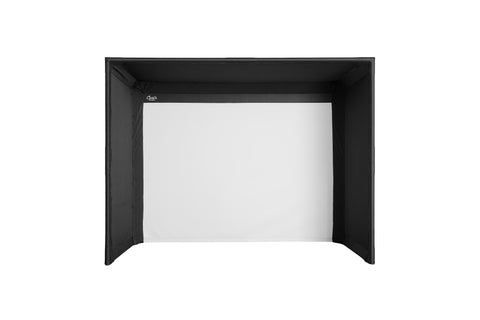
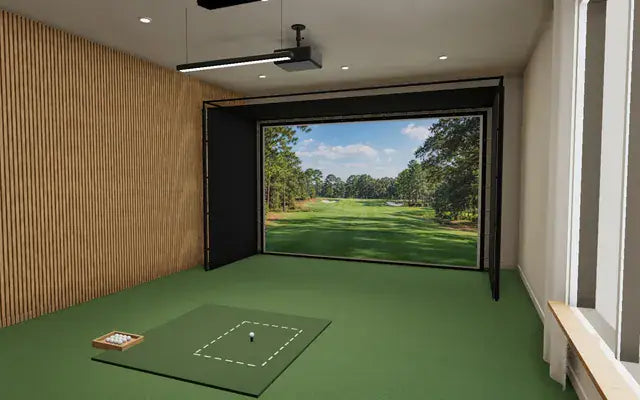
The GOLFJOY P8 kit puts the Spica 3 with an Optoma GT2300HDR projector, an enclosure and impact screen, turf, a hitting mat and a year of GOLFJOY's Professional software. GOLFJOY gives the kit about 10 ft by 13 ft 10 in with its turf, and about 16 ft of room depth for a full swing. Our P8 vs P7 page shows the room drawing.
More comparisons: FlightScope Mevo Gen2 vs GOLFJOY Spica 3 (another radar unit against the Spica 3), Spica 3 vs Uneekor EYE MINI and launch monitors compared.
Products in this guide
Sources
- Garmin, Approach R10 Owner's Manual: Preparing for a Shot (read 2026-11-01): Garmin's Approach R10 manual says that indoors the tee must be at least 8 ft (2.4 m) from the net; to place the launch monitor on the ground 6 to 8 ft (1.8 to 2.4 m) behind the tee, with its bottom edge above the mat if you use a golf mat, and its red alignment line on the tee and the target; and that the tee can move up to 1 ft either side of the target line, within a 2 × 2 ft hitting area that begins 6 ft from the launch monitor
- GOLFJOY, Spica 3: For indoor use GOLFJOY asks for at least 2 yards (about 1.8 m) from the hitting position to the screen or net and a ceiling of 2.75–3.1 m (9–10.2 ft) for the Spica 3, and lines its bottom edge up parallel with the edge of the hitting mat.
- Garmin, Approach R10 (garmin.com, read 2026-11-09): Garmin's Approach R10 page lists it at $499.99 (U.S. list price, read Nov 9, 2026), gives its measurement technology as radar, lists 14 launch monitor metrics (club head speed, club face angle, club path angle, angle of attack, ball speed, launch angle, launch direction, spin axis, spin rate, apex height, smash factor, carry distance, total distance and deviation distance), lists Home Tee Hero course play 'with active subscription' and compatibility with third-party simulators, and lists in the box the R10, a tripod stand, a phone mount, a carry case, a microUSB cable and documentation.
- GOLFJOY, Spica 3: GOLFJOY's Spica 3 is a portable launch monitor with three high-speed cameras and two LED lights that tracks 27 ball, club and trajectory data points (golfjoy.com/products/spica-3, read Nov 10, 2026), runs up to 7 hours on its built-in battery, connects to GOLFJOY's apps by Wi-Fi and to a PC by Ethernet, reads any ball including pure white ones, needs club stickers for club data, and works with GOLFJOY PRO, GSPro, E6 Connect and Creative Golf.
- Garmin, Approach R10 Owner's Manual: Specifications (read 2026-11-01): Garmin lists the Approach R10's battery life as up to 10 hours from a built-in rechargeable lithium-ion battery, its operating temperature as 14 to 131°F (-10 to 55°C) and its water rating as IPX7
- Garmin, Approach R10 Owner's Manual: Connecting to a Third-Party Simulator; Tips for Improving the Launch Monitor's Accuracy (read 2026-11-01): Garmin's Approach R10 manual says its golf simulator features run in the Garmin Golf and Home Tee Hero apps, and that you connect to compatible third-party simulator software from the Garmin Golf app (Other Simulators); for accuracy it says to enter the exact distance between the launch monitor and the tee when prompted, set weather conditions that match where you usually play, and adjust the unit's alignment
- GOLFJOY, Spica 3 leaflet (PDF), supplied to ParVista Golf by GOLFJOY, Oct 19, 2026: GOLFJOY's Spica 3 leaflet describes a portable launch monitor with three high-speed cameras, dual LED lights and a built-in touch screen; it measures ball speed, launch angle, launch direction, back spin, side spin, spin axis and spin rate, and, with club stickers, club speed, smash factor, attack angle, club path and low point, with up to 24 trajectory metrics in the GOLFJOY Pro app and PC software; it lists a 12,800 mAh battery that lasts up to 7.5 hours per charge, connection to apps by Bluetooth and to a PC by Ethernet, GOLFJOY Pro, E6, GSPro and Creative Golf, use indoors and outdoors, and 3 kg.
- GOLFJOY, Spica 3 FAQ: GOLFJOY's Spica 3 FAQ says the Spica 3 doesn't require any mandatory subscription or annual fees to operate, that you only pay for the simulation software you choose, and that it runs with GSPro, E6 Connect and Creative Golf; it names no GOLFJOY plan for using GSPro (read Oct 26, 2026).
- GOLFJOY, P8 Golf Simulator Package (golfjoy.com, read 2026-11-09): GOLFJOY's P8 package page lists the P8 at $5,739 in its U.S. shop (its Black Friday price, read Nov 21, 2026), with the Spica 3, an Optoma GT2300HDR short-throw projector with mount and cabling (golfjoy.com, read Nov 17, 2026; it listed a BenQ LH600ST on Nov 10), the enclosure and slow-rebound impact screen, a hitting mat and turf, 12 months of GOLFJOY Professional (30 courses) and setup accessories; it gives the space needed as an enclosure 10' W × 8.2' H × 4.9' D and about 16' of total room depth for a full swing, calls the spring-snap enclosure tool-less with assembly in about three hours, prices GOLFJOY Professional at $249 a year after the first 12 months (or GOLFJOY Diamond, 160 courses, at $799 a year), and says the kit does not include a computer.
How this guide was made: ParVista Golf compiled it from manufacturers' published requirements and the public sources listed above. Requirements for a specific product always come from its manufacturer.


