
On this page · 7 sections
Can I buy a home golf simulator from an Indianapolis company?
Yes. ParVista Golf is an online store for home golf simulator rooms, based in Indianapolis and operated by SUHAIB COMMERCE LLC, an Indiana company. We don't have a showroom or a store you can visit: you order online, and each product ships straight from its maker to your door anywhere in Indiana. Every product page shows who ships it and how long it takes.
Before you buy, you can send us your room's size for a free written room plan, usually within one business day. Our company details page shows where to look us up in Indiana's public business records.
How much room does a home simulator need?
Makers' figures are the place to start. TruGolf calls about 10 ft wide, 12 to 15 ft deep and a 9 ft ceiling the practical minimum, and Carl's Place recommends at least 10 ft of width, or 14 ft if the tee is centered for both right- and left-handed golfers. For a garage, BenQ gives at least 9 ft of height, 10 ft of width and 14 ft of depth, and Carl's Place calls 14 ft wide, 18 ft deep and 10 ft high ideal.
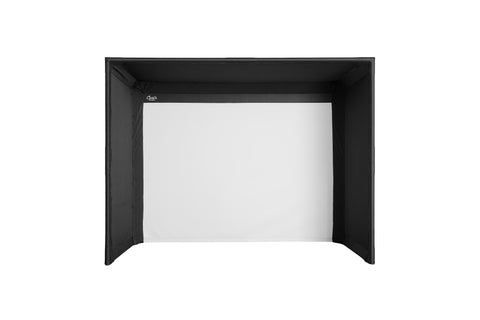
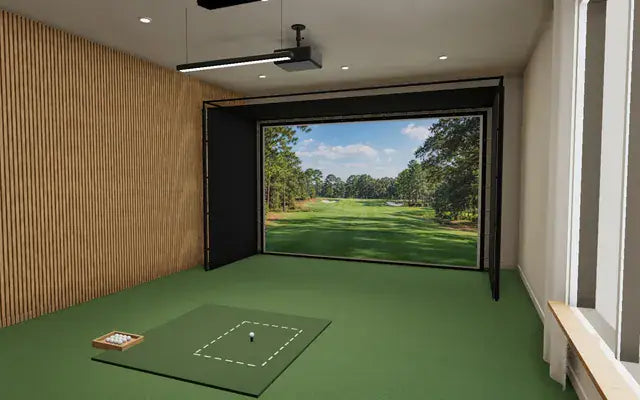
A complete kit shows what that means in practice: GOLFJOY's P8 covers about 10 ft by 13 ft 10 in with its turf and wants about 16 ft of room depth and a ceiling of at least 9 ft 2 in. Our room size guide walks through each measurement.
Garages and basements: what to plan for
Most Indiana simulators go in a garage or a basement, and both see real winters and humid summers. For a garage, BenQ suggests insulating the walls and all around the garage door, says a dehumidifier may be needed, and asks for care with an overhead launch monitor or a ceiling-mounted projector; it also recommends a projector with a sealed light engine that works in both heat and cold. Carl's Place suggests planning insulation and plenty of power outlets from the start, and TrackMan says you can still park a car in the garage as long as nothing blocks the simulator while you play.
In a basement the ceiling usually decides it: our basement golf simulator guide sorts the launch monitors we sell by the ceiling height they need, and the garage golf simulator guide covers door tracks and parking the car.
What does renting a simulator bay around Indianapolis cost?
If you're weighing a home setup against renting, here's what nearby venues published (Nov 6, 2026, per bay, per hour): Circle City Indoor Golf in Broad Ripple $30 to $50; Pebble Brook Golf Club in Noblesville $45 to $60; Speedway Indoor Karting $50. Topgolf Fishers prices by the hour per bay too. Our is a home golf simulator worth it? guide works through the numbers.
Popular setups, at today's prices
Read live from our store and our policies each time this page loads, including who ships each item and from where.
| Product | Price today | How to buy | Ships from | Returns | Warranty |
|---|---|---|---|---|---|
| GOLFJOY P8 Golf Simulator Kit with Spica 3 Launch Monitor | $5,739 | Add to cart | GOLFJOY in Irvine, California, by curbside pallet freight | within 30 days of delivery if unused, with every part in the original packaging and our approval first; no restocking fee; you pay the return shipping to GOLFJOY | 1-year full-coverage warranty |
| GOLFJOY Spica 3 Portable Launch Monitor | $2,239 | Add to cart | GOLFJOY in Irvine, California, by FedEx ground | within 30 days of delivery if unused, with every part in the original packaging and our approval first; no restocking fee; you pay the return shipping to GOLFJOY | 1-year full-coverage warranty |
| Uneekor EYE MINI LITE Launch Monitor | $1,699 | Add to cart | its maker or Carl's Place | 15 days from activating the software or 60 days from delivery, whichever comes first; a 15% restocking fee; you pay the return shipping | 2 years on overhead units; 1 year on the EYE MINI, EYE MINI LITE and accessories |
| Carl's Place DIY Golf Enclosure Kit with Impact Screen | From $849.96 | Add to cart | Milton, Wisconsin (made to order) | 30 days from delivery, like-new; a 30% restocking fee if it's been used; you pay the return shipping | A defective part replaced free within 30 days of delivery; normal wear isn't covered (Carl's Place treats its products as wearable) |
| BenQ AH500ST 1080p Laser Short-Throw Golf Simulator Projector | $1,999 | Add to cart | BenQ America | 30 days from delivery; you pay the return shipping, plus a 15% restocking fee if the box has been opened | 3-year limited warranty, parts and labor |
Prices and stock are read live from our store each time this page loads, at each maker's advertised price. Taxes and any shipping charge show at checkout; the full terms are on each product page and in our refund policy.
Delivery, tax and setup in Indiana
Delivery is to your door; nothing is picked up in Indianapolis. Sales tax, if any, is calculated at checkout from your delivery address. Most of the kits we sell are built for do-it-yourself setup, and we help by email before and after you buy: see golf simulator installation for what each kit involves. Want it all chosen for you? Our complete golf simulator packages list the full rooms we sell.
Products in this guide
Shop by room
Sources
- TruGolf, Golf Simulator Room Dimensions: The practical minimum is around 10 ft wide, 12–15 ft deep, and a 9 ft ceiling, and that will feel tight with longer clubs.
- Carl's Place, Measuring Your Space For An Indoor Golf Simulator: Carl's Place recommends a room at least 10 ft wide for indoor golf, and at least 14 ft wide if the tee is centered to accommodate both right- and left-handed golfers; with less width, it says you can offset the tee.
- BenQ, Tips for Building a Golf Sim in Your Garage: BenQ says a garage golf simulator needs at least 9 ft of height, 10 ft of width and 14 ft of depth, says to proceed with care with an overhead launch monitor or a ceiling-mounted projector, suggests insulating the garage walls and all around the garage door, says a dehumidifier may be needed, and suggests keeping light off the screen with a dimmable light that has an adjustable angle.
- Carl's Place, Garage Golf Simulator: An Easy DIY Setup: Carl's Place says an ideal garage space is 14 ft wide, 18 ft deep and 10 ft high, suggests thinking about insulating the garage at the planning stage, says to make sure there are plenty of power outlets in convenient places, and suggests a projector with a higher lumen output if the garage has windows or a lot of ambient light.
- GOLFJOY, P8 Golf Simulator Package (golfjoy.com, read 2026-11-09): GOLFJOY sells its complete P8 simulator package with the Spica 3 launch monitor (GOLFJOY has retired the P7 version with the GDS Pro). GOLFJOY lists six included components: the Spica 3; an Optoma GT2300HDR short-throw projector with its mount and cabling; the enclosure and slow-rebound impact screen; a hitting mat and turf; the first 12 months of GOLFJOY Professional (30 courses, then $249 a year); and a ball tray, club stickers, a rubber tee and the Spica 3 carry backpack. A Windows simulator PC is not included. The enclosure is 10 ft wide × 8.2 ft high × 4.9 ft deep, and GOLFJOY says to allow about 16 ft of total room depth for a full swing; the spring-snap enclosure is designed for tool-less assembly in about three hours.
- GOLFJOY, P8 Golf Simulator Package (golfjoy.com, read 2026-11-09): GOLFJOY's P8 package page lists the P8 at $5,739 in its U.S. shop (its Black Friday price, read Nov 21, 2026), with the Spica 3, an Optoma GT2300HDR short-throw projector with mount and cabling (golfjoy.com, read Nov 17, 2026; it listed a BenQ LH600ST on Nov 10), the enclosure and slow-rebound impact screen, a hitting mat and turf, 12 months of GOLFJOY Professional (30 courses) and setup accessories; it gives the space needed as an enclosure 10' W × 8.2' H × 4.9' D and about 16' of total room depth for a full swing, calls the spring-snap enclosure tool-less with assembly in about three hours, prices GOLFJOY Professional at $249 a year after the first 12 months (or GOLFJOY Diamond, 160 courses, at $799 a year), and says the kit does not include a computer.
- BenQ, What Are the Best Projectors for a Garage Golf Simulator?: For a garage, BenQ suggests a projector with a sealed light engine to keep dust out, and one that performs reliably in both hot and cold environments.
- TrackMan, Garage golf simulator: The complete guide to building your home setup with Trackman: TrackMan says you can still park a car in a garage with a simulator, as long as nothing obstructs the simulator while you play and the car isn't where it can get damaged; it suggests a dehumidifier if the garage tends to get moist, says a hitting mat can reduce strain on your joints and protect the floor, calls even lighting one of the most important features, and says a stable internet connection is a must for software updates.
- Circle City Indoor Golf: Circle City Indoor Golf, Indianapolis (Broad Ripple): public reservations $30 to $50 per bay, per hour, depending on the day and time; up to four people per bay; no membership required. Published Nov 6, 2026.
- Pebble Brook Golf Club, Indoor Golf Simulator: Pebble Brook Golf Club, Noblesville, Indiana: indoor simulator $45 an hour Monday to Thursday before 3 p.m., $55 after 3 p.m., $60 Friday to Sunday; up to eight people, four recommended. Published Nov 6, 2026.
- Speedway Indoor Karting, Golf & Sport Sim: Speedway Indoor Karting, Speedway, Indiana: golf and multi-sport simulator $50 per bay for 1 hour; up to 8 people per bay. Published Nov 6, 2026.
- Topgolf Fishers: Topgolf Fishers (Indianapolis): prices are per hour, per hitting bay; each bay fits up to 6 players; prices exclude sales tax; $6 account activation fee for new players.
How this guide was made: ParVista Golf compiled it from manufacturers' published requirements and the public sources listed above. Requirements for a specific product always come from its manufacturer.


