On this page · 9 sections
Does a golf simulator work in a gym?
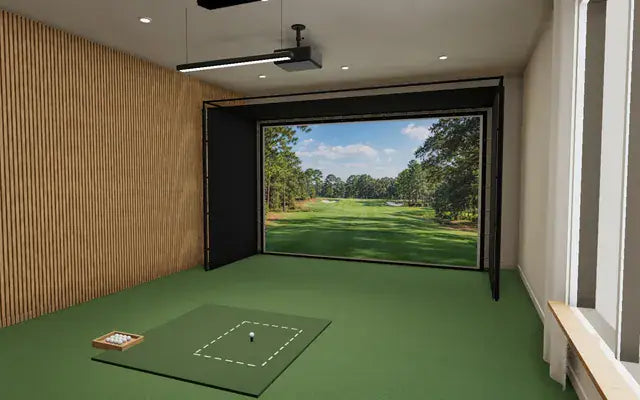
Yes, as a room members book, the way they book a court. It isn't a home bay with more users, though. A club bay has to fit right- and left-handed members, the launch monitor shouldn't sit where a gym bag or a water bottle lands on it, the ball noise has to stay out of the class next door, and the screen and mat take far more swings a week, so they're parts you plan to replace.
Before you buy, send us the room's width, depth and ceiling height and we'll send a free written plan for the bay.
Room size for a members' bay
Plan for both hands from the start. Carl's Place asks for at least 14 ft of width for a bay that serves left- and right-handed golfers and a minimum height of 10 ft in a commercial space. TrackMan calls 15 ft or more of width a strong benchmark, and says width matters even more in shared spaces, because it lets both-handed players rotate and gives people room to move safely around the hitting area.
For depth, Carl's Place builds its 18 ft recommendation from 12 to 16 in behind the screen, 10 to 12 ft from tee to screen and 7 ft behind the tee, and says seating needs more. Uneekor recommends a room at least 13 ft wide, 16 ft deep and 10 ft high for its EYE XO2.
Measure the room before you choose it: the ceiling is the hardest dimension to change. Our room size guide covers each dimension.
A launch monitor members can't knock over
Carl's Place says overhead or mounted launch monitors are popular in commercial setups because they keep equipment off the floor and away from customers, bags and drinks, and that floor units can work but need more protection. Overhead units also suit shared bays, because right- and left-handed golfers use them without moving the unit.
The overhead units we sell all say so for themselves: SwingCraft says one VTrack setup supports both hands with no reconfiguration, TruGolf says the APOGEE's mounting makes switching seamless, GOLFJOY says players can share a Rigel 3 Pro bay without moving the monitor, and AccuGOLF builds the Hawkeye for both hands, in a room 16 to 17 ft wide when it serves both. Our overhead launch monitor guide covers the ceiling heights each one needs.
A floor unit works if it lives in a corner of a quieter room. On GOLFJOY's Spica 3 a left-handed member switches handedness in the menu on its screen.
Keeping the noise out of the class next door
Most of the sound comes from the ball hitting the screen, so start there. Multi-layer screens cushion the ball with spacer yarns between two layers, and that inner layer dampens the sound of the strike. GolfBays rates its screens out of 10 for noise and bounce-back: its PRO+ scores 10 and its Close-Knit Baffle 8, and GolfBays calls the Close-Knit Baffle one of its quietest options.
Around the screen, Carl's Place's acoustic tiles absorb sound and give walls and ceilings some protection. Beyond that it's a choice of room: put the bay against a storage room or an office rather than the wall of a yoga or spin studio, and if it must share a wall, keep the busiest golf hours away from the quietest classes.
Wear parts: screens, mats and hitting strips
Carl's Place says a screen struck all day in a commercial bay wears faster than an occasional home user's, and that marks from high-spin shots are normal wear. SimSpace puts numbers on it: its warranty policy gives an impact screen a maximum use expectation of 20,000 shots, about 6 months at 100 shots a day, and a hitting mat 40,000 shots, about a year at 100 shots a day, and treats reaching those counts as normal wear. Estimate how many shots your bay will take in a day and plan replacements from that.
Choose parts built for it. GolfBays rates the Close-Knit Baffle 9 out of 10 for durability and the PRO+ 10, both for heavy home and commercial use. Carl's Place's HotShot mat lets you replace the hitting insert instead of the whole mat, and its 4 × 9 ft and 6 × 10 ft sizes have a centered hitting area for both hands. Our replacement parts guide lists the spares we sell.
Running it with bookings, not staff
Most clubs can't put someone in the bay all day, so set it up to run itself. Book it in slots through the system members already use for courts or classes. Put a one-page start-up card on the wall: turn on the projector and computer, pick your profile, play. Mark a waiting line on the floor well behind the hitter and keep one golfer in the hitting area at a time.
Give regulars a profile of their own so their shots stay together. Uneekor lists 5 player profiles with its Pro membership, 50 with Champion and 100 with Ultimate, each billed yearly.
Check the software license before you charge for the bay or include it in a membership tier. GSPro's terms license it for personal, non-commercial use by one person at a time. TruGolf pairs its APOGEE with the E6 CONNECT Commercial Suite, which it built for business operations. For other programs, we confirm with the maker in writing before you order.
Parts for a club bay, at today's prices
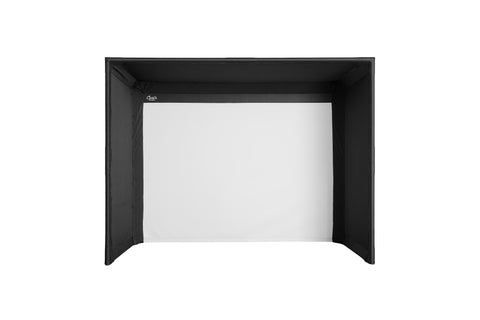
Read live from our store each time this page loads, with who ships each one and its brand's terms. Elite ProAV sells its Golf Bay Pro enclosure for commercial and professional installations, and Carl's Place custom-sizes its Pro enclosure to the inch for commercial bays.
| Product | Price today | How to buy | Ships from | Returns | Warranty |
|---|---|---|---|---|---|
| Carl's Place Pro Golf Simulator Enclosure Kit with Impact Screen | From $2,898.46 | Add to cart | Milton, Wisconsin (made to order) | 30 days from delivery, like-new; a 30% restocking fee if it's been used; you pay the return shipping | A defective part replaced free within 30 days of delivery; normal wear isn't covered (Carl's Place treats its products as wearable) |
| Elite Screens Golf Bay Pro Golf Simulator Enclosure with Impact Screen | $3,700 | Add to cart | Elite's warehouse in Garden Grove, California | 30 days from the order date; a 25% restocking fee once opened | 6 years on the Golf Bay Pro and Golf Portable Pro bought from us (Elite confirmed this in writing); 2 years on the GolfSim DIY screen |
| Golf Simulator Impact Screen - GolfBays Close Knit Baffle | From $263.16 | Add to cart | Clearwater, Florida | 30 days from the order date; GolfBays may charge a restocking fee, at least 15% on large items such as enclosures; you pay the return shipping unless GolfBays sends a free label | 9 months on the PRO+ impact screen, 6 months on GolfBays' other screens |
| Golf Simulator Impact Screen - GolfBays Pro+ | From $467.50 | Add to cart | Clearwater, Florida | 30 days from the order date; GolfBays may charge a restocking fee, at least 15% on large items such as enclosures; you pay the return shipping unless GolfBays sends a free label | 9 months on the PRO+ impact screen, 6 months on GolfBays' other screens |
| Golf Hitting Mat - Carl's Place HotShot Golf Mat System | From $499.95 | Add to cart | Milton, Wisconsin (made to order) | 30 days from delivery, like-new; a 30% restocking fee if it's been used; you pay the return shipping | A defective part replaced free within 30 days of delivery; normal wear isn't covered (Carl's Place treats its products as wearable) |
| Carl's Place HotShot Hitting Strip | From $79.95 | Add to cart | Milton, Wisconsin (made to order) | 30 days from delivery, like-new; a 30% restocking fee if it's been used; you pay the return shipping | A defective part replaced free within 30 days of delivery; normal wear isn't covered (Carl's Place treats its products as wearable) |
| Carl's Place Golf Room Acoustic Tiles (25-Pack) | $279.95 | Add to cart | Milton, Wisconsin (made to order) | 30 days from delivery, like-new; a 30% restocking fee if it's been used; you pay the return shipping | A defective part replaced free within 30 days of delivery; normal wear isn't covered (Carl's Place treats its products as wearable) |
| VTrack DX10 Overhead Launch Monitor | $5,000 | Add to cart | SwingCraft's U.S. stock, by UPS Ground | 30 days from delivery; no restocking fee; you pay the return shipping | 12-month limited manufacturer warranty |
| TruGolf APOGEE Launch Monitor | $6,500 | Add to cart | TruGolf | 14 days from delivery; a 15% restocking fee; you pay the return shipping | TruGolf's 2-year limited warranty |
| GOLFJOY Rigel 3 Pro Overhead Launch Monitor | $13,999 | Add to cart | GOLFJOY in Irvine, California, by FedEx ground | within 30 days of delivery if unused, with every part in the original packaging and our approval first; no restocking fee; you pay the return shipping to GOLFJOY | 1-year full-coverage warranty |
| Uneekor EYE XO2 Launch Monitor | $7,999 | Add to cart | Uneekor, by UPS Ground | 15 days from activating the software or 60 days from delivery, whichever comes first; a 15% restocking fee; you pay the return shipping | 2 years on overhead units; 1 year on the EYE MINI, EYE MINI LITE and accessories |
Prices and stock are read live from our store each time this page loads, at each maker's advertised price. Taxes and any shipping charge show at checkout; the full terms are on each product page and in our refund policy.
Warranty, and how a club orders
Each brand sets its own warranty, and what it covers in a club differs from brand to brand. Before you order, we confirm in writing what the brand covers for your use; nothing is promised beyond the maker's own terms.
Send the room sizes and how many bays you want from our business and multi-bay page. We reply in writing with a plan for each bay and one quote listing every part at the price on its product page, its delivery estimate and each brand's return and warranty terms. Adding several bays, or a paid-play area? Planning an indoor golf venue covers bay counts and layouts.
- How to choose a golf simulator impact screen
- Golf simulators for left-handed golfers
- Golf simulator for golf instructors: setting up a teaching studio
Products in this guide
Sources
- Carl's Place, Measuring Your Space For An Indoor Golf Simulator: For a commercial space, Carl's Place says to plan each hitting station, aim for a minimum height of 10 ft, and allow at least 14 ft of width for a bay that serves both left- and right-handed golfers; it adds that deeper bays offer more safety and that enclosure wall wear can be an issue if one side is used more often.
- TrackMan, How much room do you need for a golf simulator: TrackMan says a single right-handed golfer has very different needs from a commercial bay where right- and left-handed players rotate through all day; it gives 15 ft+ of width as a strong benchmark for one golfer, says width matters even more in commercial and shared spaces because it supports both-handed play and safer movement around the hitting area, and calls a 10 ft+ ceiling the practical minimum, with more helping taller players.
- Carl's Place, Measuring Your Space For An Indoor Golf Simulator: Carl's Place builds its 18 ft recommended room depth from 12–16 in between the screen and the wall, 10–12 ft from the tee to the screen and 7 ft behind the tee, and says this covers the play area only; extras like seating need more space.
- Uneekor, EYE XO2 AI Studio: Uneekor's EYE XO2 page lists a hitting zone of 28 × 21 in and says: "We recommend a minimum room size of 13 ft wide × 16 ft deep × 10 ft high" (read Nov 10, 2026).
- Carl's Place, Commercial Golf Simulators: Business Guide: Carl's Place says overhead or mounted launch monitors are popular in commercial setups because they keep equipment off the floor and away from customers, bags and drinks; floor units can work but need more protection.
- Carl's Place, Golf Simulator Launch Monitor: How To Choose: Overhead units keep the floor clear and suit shared bays, because right- and left-handed golfers can use them without moving the unit; ceiling height, mounting position and cable routing take more planning than a floor unit.
- SwingCraft (LAON SwingCraft's U.S. distributor), VTrack: SwingCraft's VTrack page says a single setup supports both left- and right-handed players with no reconfiguration when players swap, recommends a room at least 10 ft wide, gives the floor-to-ceiling height required as 106–122 in, and lists no subscription fees (read Nov 10, 2026).
- TruGolf, APOGEE By TruGolf: TruGolf says its ceiling-mounted APOGEE measures club and ball data without marked clubs or specialty balls, and that its mounting position makes play between right- and left-handed golfers seamless.
- GOLFJOY, Rigel 3 Pro: GOLFJOY's Rigel 3 Pro page says left- and right-handed players can share the bay without moving the monitor between groups, gives a 9–10.2 ft ceiling for the overhead unit in its S300 and S Series Pro packages, and notes that its S500 Elite package is for right-handed golfers only (read Nov 10, 2026).
- AccuGOLF, Hawkeye Simulator: AccuGOLF's Hawkeye is a ceiling golf simulator for right- and left-handed golfers; its dual cameras capture at more than 1,000 frames per second and measure ball speed and launch angle directly, AccuGOLF's machine-learning algorithm calculates spin, and it reports club data such as club speed, club path, attack angle, face angle and dynamic loft.
- AccuGOLF, Hawkeye Simulator: AccuGOLF's minimum room for the Hawkeye is 12 ft wide, 9 ft high and 14 ft deep for single-handed rooms, and 16–17 ft wide, 9 ft high and 14 ft deep for rooms built for both hands; its hitting zone is 24 in wide by 12 in long.
- GOLFJOY, FAQs: GOLFJOY's support FAQ answers that the Spica 3 works for left-handed golfers: "Select Handedness in the menu on the Spica 3 screen to switch between right-handed and left-handed modes" (read Nov 10, 2026).
- The Indoor Golf Shop, What are the differences between SIG brand impact screens?: Multi-layer screens put spacer yarns between two polyester layers to cushion the ball (quieter, less bounce-back); single-layer woven screens cost less but can carry shorter warranties.
- Elite Screens, GolfSim DIY Screen Series: ImpactWhite 1145: In a three-layer screen, the internal spacer layer dampens the noise of the ball hitting the screen.
- GolfBays, Impact Screen FAQs & Guidance: GolfBays rates its screens from 1 to 10 (most positive): Lite (light home use) durability 6, image quality 6, noise and bounce-back 5; PRO Reversible (heavy home use, HD) 7, 7 and 4; Close-Knit Baffle (heavy home and commercial use) 9, 5 and 8; PRO+ (heavy home and commercial use, HD/4K) 10, 9 and 10.
- GolfBays, Close-Knit Baffle Simulator Impact Screen: GolfBays describes the Close-Knit Baffle as a close-knit polyester archery baffle screen whose small holes dissipate sound, one of its quietest options; it's single layer but can be reversed, has eyelets every 8 in around all four sides, and comes in 11 sizes from 7'6 × 8'5 to 16'4 × 9'10, all dimensions including the white surround.
- Carl's Place, Golf Room Acoustic Tiles: Carl's Place says its golf room acoustic tiles, 24 × 24 in and 9 mm thick in packs of 25 covering 100 sq ft, absorb sound, help control ambient light and give walls and ceilings some protection; they're adhesive-backed for plywood, drywall or painted drywall (the adhesive can damage paint), with an extra fastener suggested on a ceiling.
- Carl's Place, How to Choose a Golf Impact Screen Material: Impact screens wear: one hit all day in a commercial bay wears faster than an occasional home user's, and marks from high-spin shots are normal wear.
- SimSpace Golf, Warranty Policy: SimSpace's warranty policy says normal wear and tear isn't covered, and gives impact screens a maximum use expectation of 20,000 shots (about 6 months at 100 shots a day) and hitting mats 40,000 shots (about 1 year at 100 shots a day); reaching those counts is generally treated as normal wear. It advises turning a mat 90 degrees every few weeks.
- Carl's Place, Carl's HotShot Golf Mat System: Carl's Place says its HotShot mats let you replace the hitting area without replacing the entire mat; the hitting inserts measure 30 × 12 × 1.75 in.
- Carl's Place, Carl's HotShot Golf Mat System: Carl's Place sells the HotShot mat 1¾ in thick in 4 × 5 ft and 5 × 8 ft (offset hitting area) and 4 × 9 ft and 6 × 10 ft (centered hitting area); it says the optional EPDM rubber base stops the mat shifting during powerful swings and adds cushioning to protect your joints, and calls its Foam Divot insert the most forgiving option on your joints.
- Uneekor, Golf Simulator Software and Memberships: Uneekor's memberships page lists Player free with every launch monitor, Pro $199 a year (third-party software, 5 profiles), Pro+ $299 a year (Pro plus a 1-year GSPro subscription), Champion $399 a year (AI Trainer, which needs Swing Optix cameras; 50 profiles), Champion+ $499, Ultimate $599 (GAMEDAY, which needs two displays; 100 profiles) and Ultimate+ $699, each billed annually; it says GSPro on a Uneekor unit needs an active Pro, Champion or Ultimate membership (read Nov 10, 2026).
- GSPro, Terms of Service and End User License Agreement: GSPro's terms grant a limited license to use its services for personal, non-commercial enjoyment, by only one person at a time.
- TruGolf, Commercial Golf Simulator Solutions: TruGolf's commercial system pairs its ceiling-mounted APOGEE launch monitor with the E6 CONNECT Commercial Suite, a software platform designed specifically for business operations.
- Elite ProAV, Golf Bay Pro Series: Elite ProAV sells its Golf Bay Pro enclosure for commercial and professional installations in 10 × 10 ft and 13 × 10 ft sizes, with the impact screen, ball bungees, metal frame tubes, corner fittings and enclosure cover panels included; it lists a 5-year warranty, and a 6-year warranty for education, non-profit, religious and government organizations. Bought from us, Elite's Pro screens carry 6 years (Elite confirmed this in writing).
- Carl's Place, Pro Golf Simulator Enclosure Kit: Carl's Place says its Pro Enclosure can be custom-sized down to the inch, which it calls ideal for commercial simulator bays where every dimension matters, and recommends 12 in behind the enclosure, with 9.5 in the minimum to fit the rear fittings.
How this guide was made: ParVista Golf compiled it from manufacturers' published requirements and the public sources listed above. Requirements for a specific product always come from its manufacturer.


