On this page · 12 sections
What does a SkyTrak need around it?
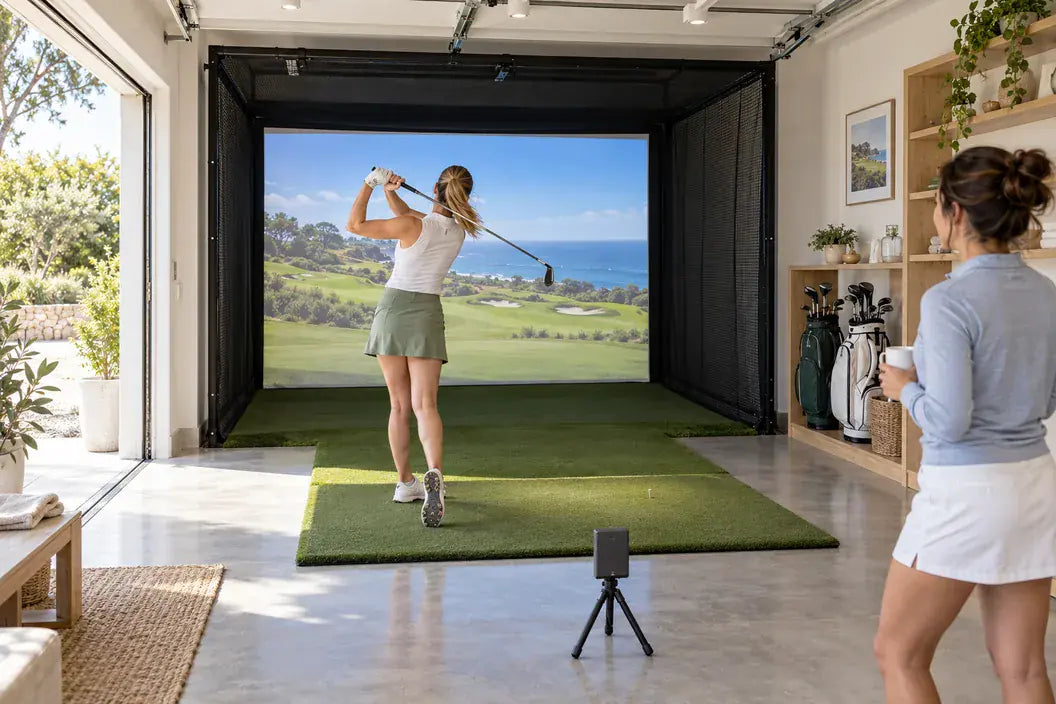
Less depth than most. A SkyTrak sits next to the ball rather than behind it, so the room doesn't have to hold several feet of space behind the golfer for the launch monitor. SkyTrak's knowledge base gives a minimum hitting bay of 12 ft long, 10 ft wide and a 9 ft net height, and recommends 15 ft long, 15 ft wide and 10 ft high.
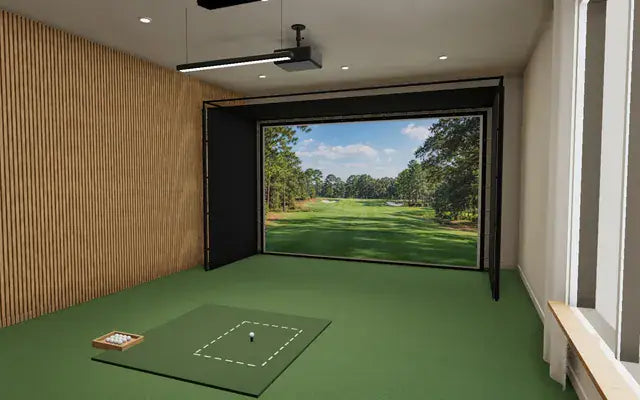
Around the unit you need something to hit into (a net, or an impact screen inside an enclosure), a mat to hit from, and, for course play, a projector and SkyTrak's software. SkyTrak describes the ST+ as dual Doppler radar with a photometric camera.
We don't sell the SkyTrak, and we aren't a SkyTrak dealer. The SkyTrak figures on this page come from its maker's own published pages; the products we point to are ones we do sell, with their makers' own figures.
Looking up Sky Trak golf or a SkyTrak golf launch monitor? We don't sell it, but we do sell what goes around it. These figures are for the SkyTrak as its knowledge base gives them, so check SkyTrak's own pages for any other model, such as a SkyTrak SIG8 golf simulator.
For a SkyTrak golf simulator price or a SkyTrak golf simulator package, check SkyTrak's site, because we don't sell them. Our launch monitor alternatives guide shows the public prices we could read. A SkyTrak home golf simulator or SkyTrak indoor golf simulator still needs the parts below.
SkyTrak's room figures
From SkyTrak's Plan Your Space page and its knowledge base.
| Measurement | SkyTrak's figure |
|---|---|
| Room length (depth) | 12 ft minimum, 15 ft recommended; SkyTrak calls 17 ft comfortable |
| Hitting distance | About 10 ft for hitting, plus 1–2 ft of clearance behind the net |
| Room width | 10 ft minimum, 15 ft recommended; SkyTrak generally suggests 12 ft |
| Right- and left-handed players | Add 1–2 ft of width |
| Height | 9 ft net height minimum, depending on your height; 10 ft recommended, and SkyTrak says many golfers find 9 ft enough |
| Where the unit goes | Next to the ball, on the hitting surface or at the same height, as level as possible |
SkyTrak also says nets, screens and enclosures have their own minimum heights, so check those against your ceiling, and to take a slow practice swing with a driver in the space before you buy anything.
Where the SkyTrak and the ball go
SkyTrak's tips are to hit off a mat designed for golf, with the ball or the base of the tee on the red laser dot. It says putting the ball 1–2 in behind the laser may help with drivers and woods, and 1–2 in in front of it with wedges.
The unit should sit on the hitting surface or at the same height, as level as possible. That matters with a thick mat: Real Feel's Country Club Elite and Carl's Place HotShot mats are both 1¾ in thick, so either set the SkyTrak on the mat itself or raise it by the same amount. A larger mat leaves room for the unit on the mat: HotShot comes 4 × 5 ft and 5 × 8 ft with an offset hitting area, and 4 × 9 ft and 6 × 10 ft with a centered one. Real Feel says driver typically needs 5 ft of mat from heel to toe.
Nets and enclosures that fit SkyTrak's numbers
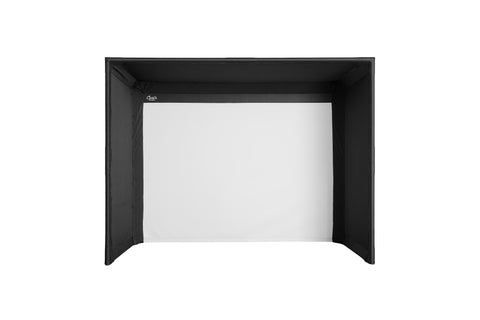
SkyTrak's minimum setup is a net; course play needs a surface to project on. These are what we sell, with each maker's own size and clearance. Inner and outer sizes differ by maker, so check which one you're reading.
| Product | Size the maker gives | Clearance the maker asks for |
|---|---|---|
| SimSpace Deluxe Home Golf Practice Net with the Driving Net Impact Screen | Frame 2.5 × 2.5 × 0.91 m (about 8 ft 2 in square, 3 ft deep) | 50 cm behind, 20 cm each side |
| SimSpace Golf Enclosure | Six sizes, inner frame 2.6 × 2.5 × 1.5 m to 4.0 × 3.0 × 3.0 m | 50 cm behind, 20 cm each side |
| GolfBays SimBox | Seven sizes, 8'6 × 8'2 × 4'11 to 13'2 × 9'10 × 9'10 | Room at least 2.8 m (9.2 ft) high and 3 m (9.8 ft) wide |
| Carl's Place DIY Golf Enclosure Kit | Six sizes, 100–163.3 in wide, 95.8–112 in tall, 59.125 in deep | 12 in behind recommended, 8.25 in minimum |
| HomeCourse ProScreen 180 | Retractable; for a space of 8'6 H × 10' W × 8' D | 6 in from the ceiling, 18 in from the wall |
On a 12 ft deep room, depth goes fast: SimSpace's smallest enclosure, the SIM 1, is 1.5 m (about 4 ft 11 in) deep, and Carl's DIY kit 59.125 in. GolfBays recommends a 4.5 m room depth for camera launch monitors and 5 m for radar ones; SkyTrak's own figures above are the ones to plan the launch monitor around.
If the room is shared, the ProScreen 180 retracts by remote; HomeCourse recommends 10–12 ft from front to back.
Which screen size and projector?
BenQ says many popular simulator systems, naming Garmin and SkyTrak, are designed for smaller impact screens, typically shorter than 8.5 ft tall, and that its short-throw projectors with throw ratios of 0.5 to 0.8 suit garages and basements. BenQ groups the AH500ST and LK830ST for compact spaces, and the AK700ST, AK800ST and AH700ST for screens 8.5 to 9.5 ft high.
BenQ lists the AH500ST as 1080p with a 0.499 throw ratio and the LK830ST as 4K with a 0.496 throw ratio, both 4,000 ANSI lumens; the AK700ST is 4K, 4,000 lumens, 0.69–0.83. BenQ says the best mounting spot is just behind and above the hitting area, far enough from the screen to avoid being hit. Our throw distance calculator works out where each one hangs for your screen.
Software: SkyTrak's own app
SkyTrak runs its course play inside the SkyTrak App. Its Elite membership lists 100+ courses there, including Foresight and Trackman course packs.
For a PC, SkyTrak's minimum is 64-bit Windows 10 or 11, an Intel Core i5, 8 GB of RAM, a 128 GB SSD and an Nvidia GTX 1650 or AMD Radeon 580. It says no VPN software may be installed, that macOS and iOS need an Apple M1 chip or better, that no iPhone currently works with course play, and that the first setup and license sync need the internet.
Creative Golf, the simulator software we sell, doesn't list SkyTrak among its supported launch monitors, so we don't suggest it for a SkyTrak.
Right- and left-handed players in one room
SkyTrak adds 1–2 ft of width for both. Carl's Place puts it at 14 ft wide if the tee is centered, and says you can offset the tee in a narrower room. On the mat side, the 4 × 9 and 6 × 10 ft HotShot mats put the hitting strip in the middle so right- and left-handed golfers can share it. Because a SkyTrak sits beside the ball, a left-hander's setup puts it on the other side, so leave room on both sides of the strip.
Before you order
Measure the room's length, width and lowest ceiling point, then mark where the ball, the SkyTrak and the screen will go. Leave the gap the screen maker asks for behind the screen: Carl's Place says to hang its screens at least 12–16 in from the wall, and SimSpace asks for 50 cm behind its enclosures. Carl's Place also says to stand at least 10–12 ft from the screen; closer means more bounce-back.
Our room size guide walks through each measurement.
Today's prices, shipping, returns and warranty
Read live from our store and our policies each time this page loads.
| Product | Price today | How to buy | Ships from | Returns | Warranty |
|---|---|---|---|---|---|
| SimSpace Golf Simulator Enclosure | From $1,699.99 | Add to cart | SimSpace's U.S. warehouse | No set return window: only if SimSpace agrees in writing, case by case | 1 year on enclosures, impact screens, driving nets and hitting mats, case by case |
| GolfBays SimBox Golf Simulator Enclosure | From $1,399.30 | Add to cart | Clearwater, Florida | 30 days from the order date; GolfBays may charge a restocking fee, at least 15% on large items such as enclosures; you pay the return shipping unless GolfBays sends a free label | 9 months on the PRO+ impact screen, 6 months on GolfBays' other screens |
| Carl's Place DIY Golf Enclosure Kit with Impact Screen | From $849.96 | Add to cart | Milton, Wisconsin (made to order) | 30 days from delivery, like-new; a 30% restocking fee if it's been used; you pay the return shipping | A defective part replaced free within 30 days of delivery; normal wear isn't covered (Carl's Place treats its products as wearable) |
| SimSpace Deluxe Home Golf Practice Net | $449.99 | Add to cart | SimSpace's U.S. warehouse | No set return window: only if SimSpace agrees in writing, case by case | 1 year on enclosures, impact screens, driving nets and hitting mats, case by case |
| Carl's Place HotShot Golf Mat System | From $499.95 | Add to cart | Milton, Wisconsin (made to order) | 30 days from delivery, like-new; a 30% restocking fee if it's been used; you pay the return shipping | A defective part replaced free within 30 days of delivery; normal wear isn't covered (Carl's Place treats its products as wearable) |
| Real Feel Country Club Elite Golf Mat | From $287 | Add to cart | Real Feel Golf Mats | 90 days from delivery; the return shipping is taken from the refund | 3-year prorated limited warranty on the full-size mats, when rotated properly |
| BenQ AH500ST 1080p Laser Short-Throw Golf Simulator Projector | $1,999 | Add to cart | BenQ America | 30 days from delivery; you pay the return shipping, plus a 15% restocking fee if the box has been opened | 3-year limited warranty, parts and labor |
| BenQ LK830ST 4K Laser Short-Throw Golf Simulator Projector, 0.5 Throw Ratio | $2,499 | Add to cart | BenQ America | 30 days from delivery; you pay the return shipping, plus a 15% restocking fee if the box has been opened | 3-year limited warranty, parts and labor |
| BenQ AK700ST 4K Laser Short-Throw Golf Simulator Projector | $2,899 | Add to cart | BenQ America | 30 days from delivery; you pay the return shipping, plus a 15% restocking fee if the box has been opened | 3-year limited warranty, parts and labor |
| HomeCourse ProScreen 180 Retractable Golf Screen | $2,299 | Sold out | HomeCourse's Florida warehouse, by FedEx | 30 days from the order date, with HomeCourse's approval; a 15% restocking fee; you pay the return shipping | 1 year on the ProScreen 180 and its accessories |
Prices and stock are read live from our store each time this page loads, at each maker's advertised price. Taxes and any shipping charge show at checkout; the full terms are on each product page and in our refund policy.
Plan the room around your SkyTrak or SkyTrak+
Already have the SkyTrak or SkyTrak+? Start the Room Advisor from it: give your room's ceiling, width and depth and it checks the SkyTrak or SkyTrak+ against its maker's figures (a hitting bay at least 12 ft long, 10 ft wide and 9 ft high (net height), about 10 ft of it for hitting), then puts an enclosure and screen, a projector and a mat around it at today's prices. The tape-out sheet draws the same layout to scale for your floor.
- Room Advisor, starting from your SkyTrak or SkyTrak+
- Tape-out floor template: the frame, the ball and the launch monitor spot, to scale
- Ceiling calculator: your height, your mat, your ceiling
Related guides
More on the parts around a launch monitor.
- Golf simulator room size: dimensions and space you need
- How to choose a golf simulator enclosure
- Golf simulator hitting mats
- Golf simulator projector throw distance calculator
- Golf simulator software
- Upgrade your golf simulator
- Measure your room: the checklist
- TrackMan, Foresight, SkyTrak and Full Swing alternatives
Products in this guide
- Real Feel Country Club Elite Golf Mat
- Carl's Place HotShot Golf Mat System
- SimSpace Deluxe Home Golf Practice Net
- SimSpace Driving Net Impact Screen with 20 Bungee Cords
- SimSpace Golf Simulator Enclosure
- GolfBays SimBox Golf Simulator Enclosure
- Carl's Place DIY Golf Enclosure Kit with Impact Screen
- HomeCourse ProScreen 180 Retractable Golf Screen
This guide names 3 more; see the links in the text above.
Sources
- SkyTrak, Plan Your Space: How Much Space Do You Need for a Golf Simulator? (read 2026-11-01): SkyTrak's Plan Your Space page says a 10 ft ceiling typically gives ample clearance for most golfers, though many golfers say 9 ft is enough, and that enclosures, screens and nets have their own minimum heights; that the screens and nets it offers run from 8 to 13 ft wide, that a room used by right- and left-handed players needs an extra 1 to 2 ft of width, and that it generally suggests a 12 ft wide room; and that a SkyTrak sits next to the ball, unlike launch monitors that need up to 8 ft behind the hitting area, with a 17 ft room depth giving a comfortable setup; before buying, it says to take a slow practice swing with a driver in the space you plan to use
- SkyTrak Knowledge Base, Golf Simulator Space Requirements (read 2026-11-01): SkyTrak's knowledge base says a hitting bay for its launch monitor needs about 10 ft of room length for hitting plus 1 to 2 ft of clearance behind the net, with enough height and width to swing comfortably; it gives minimum dimensions of 12 ft long, 10 ft wide and a 9 ft net height (depending on your height), and recommended dimensions of 15 ft long, 15 ft wide and 10 ft high
- SkyTrak, SKYTRAK ST+ Launch Monitor (read 2026-11-01): SkyTrak describes the SkyTrak ST+ as combining dual Doppler radar with a photometric camera system, and gives SkyTrak units a 6-month or 25,000-shot manufacturer warranty, whichever comes first, which it calls a consumer warranty covering defects in materials and workmanship under normal use; physical damage or tampering voids it
- SkyTrak Knowledge Base, Tips for Use Guide (read 2026-11-01): SkyTrak's Tips for Use Guide recommends hitting off a mat designed for golf with the ball or the base of the tee on the red laser dot; it says placing the ball 1 to 2 in behind the laser may help with drivers and woods, and 1 to 2 in in front of it with wedges, and that the unit should sit on the hitting surface or at the same height as it, as level as possible
- Real Feel Golf Mats, Country Club Elite (Real Feel's product details for our listing): Real Feel's Country Club Elite mat has a 1 in nylon-blend pile on a 5/8 in high-density foam backing (1¾ in in all), takes a real wooden tee and comes in sizes from 3 × 4 ft to 5 × 15 ft; Real Feel says the 3 × 4 and 4 × 4 ft sizes won't let most golfers hit driver, that driver typically needs 5 ft heel to toe, and that its mats can measure up to 1 in more or less than the listed size.
- Carl's Place, Carl's HotShot Golf Mat System: Carl's Place sells the HotShot mat 1¾ in thick in 4 × 5 ft and 5 × 8 ft (offset hitting area) and 4 × 9 ft and 6 × 10 ft (centered hitting area); it says the optional EPDM rubber base stops the mat shifting during powerful swings and adds cushioning to protect your joints, and calls its Foam Divot insert the most forgiving option on your joints.
- SimSpace Golf, SimSpace Practice Net + Impact Screen: SimSpace's Practice Net + Impact Screen page gives the standard net's frame as 2.5 × 2.5 × 0.91 m (W × H × D) with 3 m of side netting, and the wide net's frame as 3 × 2.5 × 0.91 m; it says to leave at least 50 cm behind and 20 cm on either side as a buffer for ball impacts, and calls all measurements estimates (read Oct 31, 2026).
- SimSpace Golf, SimSpace Driving Net Impact Screen + 20 Bungee Cords: SimSpace describes its Driving Net Impact Screen as a finely knitted, single-layer fabric with a smooth projection surface, 4K-ready, designed to match its standard and wide practice nets and also usable on its own on a custom-built frame, with 20 bungee cords that go through eyelets placed for even tension (read Oct 31, 2026).
- SimSpace Golf, SimSpace Golf Enclosure: SimSpace lists its Golf Enclosure in six sizes, with inner frames from 2.6 × 2.5 × 1.5 m (SIM 1) to 4.0 × 3.0 × 3.0 m (SIM 6) (W × H × D); it has black velour side and ceiling panels that help contain stray shots and block outside light, and a 3-layer Platinum impact screen with a foam sound-dampening layer, and SimSpace asks for at least 50 cm behind and 20 cm on either side as a buffer for ball impacts (read Oct 31, 2026).
- GolfBays, SimBox Golf Simulator Enclosure: GolfBays sells the SimBox in seven sizes (W × H × D) from 8'6 × 8'2 × 4'11 to 13'2 × 9'10 × 9'10; its box list names aluminum poles, a black velvet surround, a triple-layer HD PRO+ impact screen and an instruction manual, and its features list click tubing that assembles in about 45 minutes with no screws or tools and folds down for storage.
- GolfBays, SimBox Golf Simulator Enclosure (FAQ): For comfortable swings with any club, GolfBays recommends a ceiling of at least 2.8 m (9.2 ft), ideally 3 m (9.8 ft), and a width of at least 3 m (9.8 ft).
- Carl's Place, DIY Golf Simulator Enclosure Kit Specifications (PDF): Carl's Place's DIY enclosure spec sheet lists six standard sizes with outer frames 100 to 163.3 in wide and 95.8 to 112 in tall, all 59.125 in deep from screen to front frame and 67.375 in in footprint depth (the backset rear fitting adds 8.25 in), with 1:1, 4:3 and 16:9 screens; it calls listing sizes simplified names, says to verify the actual outer dimensions, and quotes a 1 hour assembly.
- Carl's Place, Back Cover Kit for DIY Enclosure (read 2026-11-01): On its DIY enclosure back cover kit page, Carl's Place says to leave buffer space behind the enclosure: 12 in at the rear is recommended, and at least 8.25 in is required to fit the rear fittings
- HomeCourse Golf, ProScreen 180: HomeCourse says the ProScreen 180 mounts on a ceiling, a wall or its Pro Rack and turns a space of 8'6 H × 10' W × 8' D into a golf setup; it needs at least 6 in from the ceiling and 18 in from the wall, measures 10'6 wide with the Pro Arms extended, comes with 10 to 12 ft front to back recommended, and lets you fold out one or both Pro Arms, closing one for right- or left-handed golfers.
- GolfBays, SimBox Golf Simulator Enclosure: On its SimBox page GolfBays recommends a room depth of 4.5 m for photometric (camera) launch monitors and 5 m (16.4 ft) for radar-based ones, says the SimBox screen and enclosure withstand ball speeds of over 200 mph, lists it for indoors and outdoors, and notes that astroturf grass isn't included in the SimBox bundle (read Oct 31, 2026).
- HomeCourse Golf, ProScreen 180: HomeCourse says its retractable ProScreen 180 retracts by wireless remote in under thirty seconds, giving the room back.
- BenQ, Golf Simulator Projector Buying Guide (read 2026-11-01): BenQ's golf projector buying guide says many popular golf simulator systems, such as Garmin and SkyTrak, are designed for smaller impact screens, typically shorter than 8.5 ft tall, and that BenQ short-throw projectors with throw ratios from 0.5 to 0.8 suit garages and basements, use DLP imaging and need no lamp or filter replacements
- BenQ, Golf Simulator Projectors: BenQ groups its golf projectors by space: the AK900ST and LK936ST for large spaces (over 9.5 ft in height), the AK800ST, AK700ST and AH700ST for medium spaces (8.5–9.5 ft in height), the AH500ST and LK830ST for compact spaces such as basements and garages, and the AH30ST as its value model.
- BenQ, AH500ST specifications: BenQ lists the AH500ST as a 1080p projector with 4,000 ANSI lumens and a 0.499 throw ratio.
- BenQ, LK830ST specifications: BenQ lists the LK830ST as a 4K UHD projector with 4,000 ANSI lumens and a 0.496 throw ratio, for screens up to 10 ft tall in small spaces.
- BenQ, AK700ST specifications: BenQ lists the AK700ST as a 4K UHD projector with 4,000 ANSI lumens and a 0.69–0.83 throw ratio.
- BenQ, Golf Simulator Projector Buying Guide: BenQ says most home simulators want a short-throw projector, with a throw ratio around 1.0 or less, and that the best mounting position is just behind and above the hitting area, far enough from the screen to avoid being hit; for smaller setups a 4:3 or square picture gives the most hitting-zone coverage, native 4:3 projectors have lower resolution, and a 16:9 or 16:10 projector can project a 4:3 picture. It suggests lens shift, or keystone correction, where the projector sits far off center.
- BenQ, Measure Ideal Screen Size and Projection Distance for Your Golf Simulator (Sep 15, 2026): BenQ says throw distance is how far the projector must sit from the screen to make a given picture size, and gives throw ratio = throw distance ÷ image width; for a 16:9 projector showing a 4:3 or 1:1 picture, throw ratio = (throw distance × 0.5625) ÷ image height, and × 0.6277 for a 16:10 projector. Its example: a 16:9 projector with a 0.8 throw ratio making a 14 ft wide picture sits about 11.2 ft from the screen. It says golf simulator projectors commonly use throw ratios from 0.5 to 1.1, calls 0.69–0.89 a practical balance for standard home setups that typically lets the projector sit 2–3 ft behind the hitting area, and says ratios around 0.5 can suit smaller rooms.
- SkyTrak, Elite Membership (read 2026-11-01): SkyTrak's Elite membership gives access to 100+ courses inside the SkyTrak App, including Foresight and Trackman course packs
- SkyTrak, SKYTRAK ST MAX Launch Monitor (system requirements) (read 2026-11-01): SkyTrak's minimum PC for its software is 64-bit Windows 10 or 11, an Intel Core i5 or better, 8 GB of RAM, a 128 GB SSD and an Nvidia GTX 1650 or AMD Radeon 580; it says no VPN software may be installed, that macOS and iOS need an Apple M1 chip or better, that no iPhone currently works with course play, and that an internet connection is needed for first-time setup and to sync the license
- Creative Golf, Devices (read 2026-11-01): Creative Golf's device list says Creative Golf Advanced and Golfisimo work with Garmin's Approach R10 and R50: the R10 is placed behind the tee and connects to the PC through the free Creative Golf Garmin Connecter app on a phone or tablet, and the R50 is placed next to the ball and connects over home Wi-Fi with no extra software or hardware; the list also names Uneekor, FlightScope (including Mevo+ and Gen2), ProTee VX, Foresight's GC2, GC3, GCQuad and GCHawk, GOLFJOY, Sweetspot, GSA Golf, iTrack, NVISAGE, Square Golf and NeoPace, and doesn't name SkyTrak, Rapsodo or Bushnell
- Carl's Place, Measuring Your Space For An Indoor Golf Simulator: Carl's Place recommends a room at least 10 ft wide for indoor golf, and at least 14 ft wide if the tee is centered to accommodate both right- and left-handed golfers; with less width, it says you can offset the tee.
- Carl's Place, Carl's HotShot Golf Mat System: Every HotShot mat includes Carl's Standard hitting strip, which has three pre-punched tee holes and is the only one of Carl's three strips that takes real tees; the Foam and Gel strips are sold separately, and the 4 × 9 and 6 × 10 ft mats put the strip in the middle, so right- and left-handed golfers can share the mat.
- Carl's Place, Golf Impact Screen Care & Use (PDF): Carl's Place's screen care sheet says only the front of a screen is rated for golf balls; to hang it at least 12–16 in from the wall behind it, flat enough to remove most folds but loose enough to absorb strikes; that a tighter screen bounces the ball back more but wears less, while a looser one bounces less but wears faster; to keep the screen's bottom edge as near the floor as it will go and shield the edges from direct hits, since balls striking the grommets may damage the edging; that fold marks relax over a few days to a few weeks; to use new, clean white balls and clean clubs; and to stand at least 10–12 ft from the screen.
- Carl's Place, How to Choose the Best Golf Simulator Enclosure Size: Stand at least 10–12 ft from the screen; golfers who stand closer than 10 ft get more bounce-back and a higher risk of injury.
How this guide was made: ParVista Golf compiled it from manufacturers' published requirements and the public sources listed above. Requirements for a specific product always come from its manufacturer.


