
On this page · 8 sections
Is a golf simulator good for beginners?
Yes, as a place to practice with numbers on every shot. Carl's Place says a beginner should focus on the basics, such as grip, stance and swing mechanics, and use the simulator's instant feedback to adjust. In its home practice article, a PGA coach says that for higher handicaps the fundamentals come first, that a few lessons to lock them in are worth it before you start diagnosing yourself with data, and that a home setup with remote coaching is a strong combination.
So treat it as practice between lessons, not instead of them. We don't promise a simulator will lower your scores.
The three things to start with
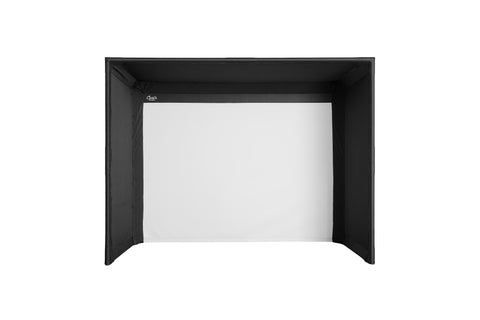
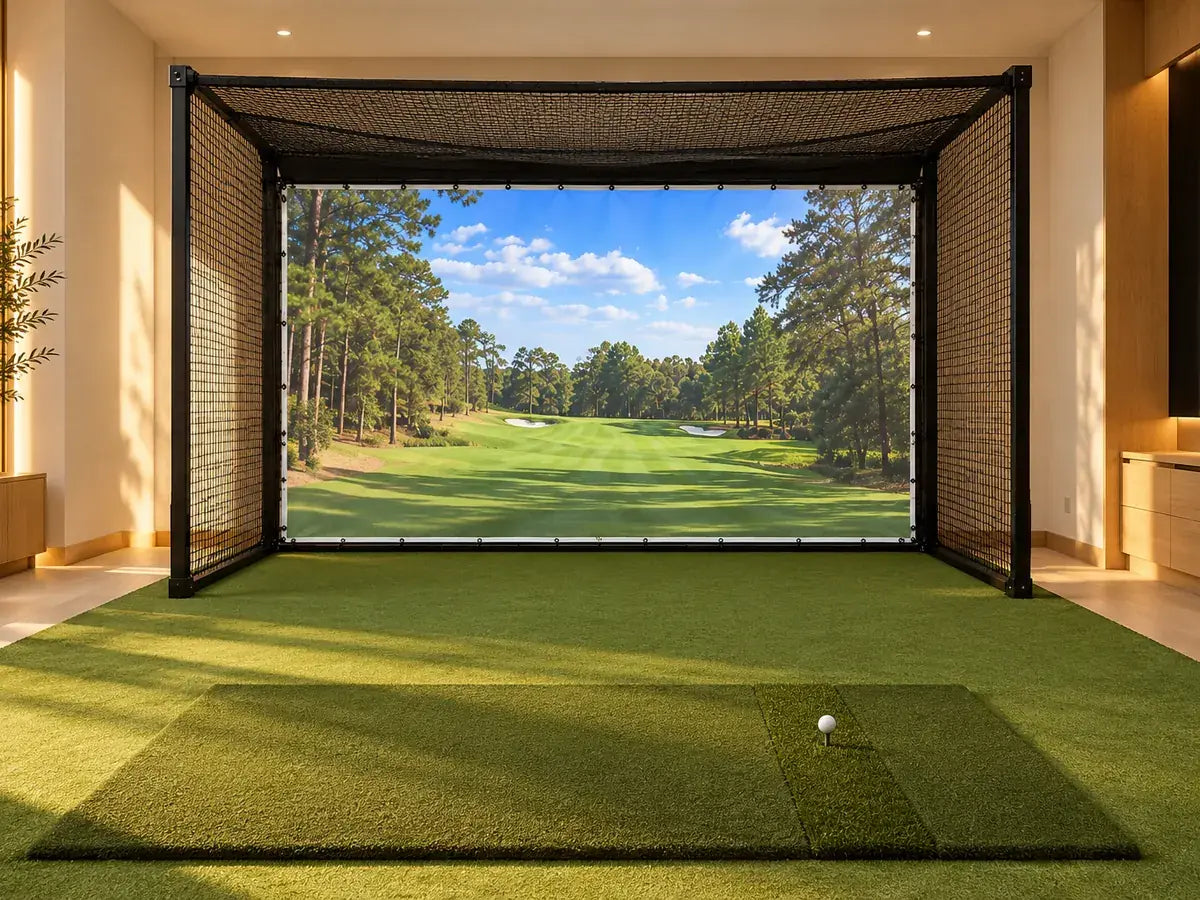
A launch monitor, something to hit into, and a mat. The launch monitor reads each shot: Carl's Place says launch monitors typically report ball speed, launch angle, spin and carry, with club data depending on the technology. A practice net or an impact screen catches the ball, and the mat gives you turf to hit from instead of the floor.
A projector and course software can come later. SimSpace's Practice Net takes a pop-on impact screen when you're ready, which links with a launch monitor and a projector for a home simulator, and comes off again for plain net practice.
Launch monitors that keep it simple
For a first setup, choose one that sits on the floor and shows your numbers without a computer. Each of these needs no ceiling mount.
FlightScope Mevo Gen2: runs in the FS Golf app on a phone, tablet or PC, with no subscription for its core features, and needs no internet. Indoors it sits 8 ft behind the ball with at least 8 ft of ball flight in front.
GOLFJOY Spica 3: three cameras, its own screen and a battery GOLFJOY rates at about 7.5 hours; it needs about 2 yards from the ball to the screen or net.
Ernest Sports ESB1 REV-D: a radar unit with a built-in screen, so no phone or app is needed. Ernest's own chart lists it for practice rather than course play.
Our portable launch monitor guide compares them in more detail.
Why a beginner's enclosure should be deep
Beginners miss the screen more often. Carl's Place says novice golfers benefit from an enclosure 10 ft deep or more that contains their shots, shanks included, and that a 5 ft deep enclosure may not be enough for wedges and higher irons from inconsistent amateurs. Its net wall extensions add 6, 8 or 10 ft of depth to an enclosure for that reason.
Stand back too. Carl's Place advises 10 to 12 ft from the screen, because closer means more bounce-back. SimSpace says to pad hard surfaces near the net or screen and keep everyone a safe distance from the swing area.
A first practice session
Carl's Place suggests a 45-minute home session: 10 minutes of wedges for contact and distance control, 15 minutes on the weakest part of your game using the launch monitor's data, three simulated holes with your full pre-shot routine, and five minutes of short game or putting.
On the numbers, the same article says to watch carry more than total distance, to compare yourself with yourself, and to treat the launch monitor as a tool, not a scoreboard. When you want more than a range, Creative Golf Advanced adds driving ranges for practice, target golf and mini golf alongside its courses.
What to leave until later
An overhead launch monitor. These mount on the ceiling inside a narrow height range: Uneekor designs its overhead units for 9 to 10 ft, and SwingCraft asks for 8 ft 10 in to 10 ft 2 in for VTrack. They make sense in a finished or shared room, less so while you find out how often you'll practice.
A gaming PC and a course subscription. GSPro, for example, is sold by the year and needs a Windows PC with at least a 3060 graphics card at 1080p. The Mevo Gen2's own app needs neither.
A premium screen. Carl's Place calls its Standard screen material a budget material for beginners; its Premium screen adds layers for a quieter strike and a smoother picture, which matter more once a projector is in.
Starter setups at today's prices
Read live from our store each time this page loads. For whole setups on a tighter budget, see our budget golf simulator guide, or send us your room and the ParVista Team will reply with what fits.
- Which simulator is right for me?
- Home and indoor golf simulator buying guide
- Is a home golf simulator worth it?
- Golf simulator software: what works with each launch monitor
| Product | Price today | How to buy | Ships from | Returns | Warranty |
|---|---|---|---|---|---|
| SimSpace Deluxe Home Golf Practice Net | $449.99 | Add to cart | SimSpace's U.S. warehouse | No set return window: only if SimSpace agrees in writing, case by case | 1 year on enclosures, impact screens, driving nets and hitting mats, case by case |
| Golf Impact Screen and Driving Net - SimSpace, with 20 Bungee Cords | $129.99 | Add to cart | SimSpace's U.S. warehouse | No set return window: only if SimSpace agrees in writing, case by case | 1 year on enclosures, impact screens, driving nets and hitting mats, case by case |
| FlightScope Mevo Gen2 Launch Monitor | $1,239 | Add to cart | its maker or Carl's Place | 30 days from delivery; a 15% restocking fee; you pay the return shipping; software is final sale | 12 months |
| GOLFJOY Spica 3 Portable Launch Monitor | $2,239 | Add to cart | GOLFJOY in Irvine, California, by FedEx ground | within 30 days of delivery if unused, with every part in the original packaging and our approval first; no restocking fee; you pay the return shipping to GOLFJOY | 1-year full-coverage warranty |
| Ernest Sports ESB1 REV-D Launch Monitor | $450 | Add to cart | Ernest Sports | 30 days from delivery, new and unopened; a 15% restocking fee | 1 year against manufacturing defects |
| GolfBays EasySim Golf Simulator Enclosure | $719.10 | Add to cart | Clearwater, Florida | 30 days from the order date; GolfBays may charge a restocking fee, at least 15% on large items such as enclosures; you pay the return shipping unless GolfBays sends a free label | 9 months on the PRO+ impact screen, 6 months on GolfBays' other screens |
| Golf Hitting Mat 4'11" x 4'11" - GolfBays Standard | From $312.55 | Add to cart | Clearwater, Florida | 30 days from the order date; GolfBays may charge a restocking fee, at least 15% on large items such as enclosures; you pay the return shipping unless GolfBays sends a free label | 9 months on the PRO+ impact screen, 6 months on GolfBays' other screens |
| Carl's Place DIY Golf Enclosure Kit with Impact Screen | From $849.96 | Add to cart | Milton, Wisconsin (made to order) | 30 days from delivery, like-new; a 30% restocking fee if it's been used; you pay the return shipping | A defective part replaced free within 30 days of delivery; normal wear isn't covered (Carl's Place treats its products as wearable) |
| Carl's Place Net Wall Extensions (Pair) | From $102 | Add to cart | Milton, Wisconsin (made to order) | 30 days from delivery, like-new; a 30% restocking fee if it's been used; you pay the return shipping | A defective part replaced free within 30 days of delivery; normal wear isn't covered (Carl's Place treats its products as wearable) |
| GOLFJOY P8 Golf Simulator Kit with Spica 3 Launch Monitor | $5,739 | Add to cart | GOLFJOY in Irvine, California, by curbside pallet freight | within 30 days of delivery if unused, with every part in the original packaging and our approval first; no restocking fee; you pay the return shipping to GOLFJOY | 1-year full-coverage warranty |
Prices and stock are read live from our store each time this page loads, at each maker's advertised price. Taxes and any shipping charge show at checkout; the full terms are on each product page and in our refund policy.
Products in this guide
Sources
- Carl's Place, Golf Simulator FAQs: What to Wear, What to Do, and More (blog, updated Feb 23, 2026; read Nov 14, 2026): Carl's Place's golf simulator FAQ (updated Feb 23, 2026) says a simulator can be both exciting and intimidating for beginners, advises a beginner to focus on the basics of the game, such as grip, stance and swing mechanics, to receive instant feedback from the simulator's sensors and adjust accordingly, and says it's all about progress, not perfection.
- Carl's Place, Learning How To Practice Golf At Home (blog, updated Sep 28, 2026; read Nov 14, 2026): Carl's Place's article on practicing golf at home (updated Sep 28, 2026) gives a 45-minute session: 10 minutes of wedges to dial in contact and distance control, 15 minutes on the weakest part of your game using launch monitor data or a combine result, three simulated holes with your full pre-shot routine, and five minutes of short game or putting; a fitter in the article favors carry over total distance and says to compare yourself to yourself, calling the launch monitor a tool, not a scoreboard; and a PGA coach says that for higher handicaps the fundamentals (grip, stance, posture, ball position and alignment) come first, that a few lessons to lock them in before self-diagnosing with data is worth the investment, and that a home setup paired with remote coaching is a strong combination.
- Carl's Place, How to choose a golf simulator launch monitor: Launch monitors typically report ball speed, launch angle, spin, and carry; club data depends on the technology.
- SimSpace Golf, SimSpace Practice Net + Impact Screen: SimSpace says its Practice Net can be put up or taken down in 10–20 minutes by two people and can be used indoors or outdoors, but must be stored in a dry, warm place after use; weighted bags (filling not included) stretch out its side netting, and its pop-on impact screen attaches by bungee cords, links with a launch monitor and a compatible projector for a home simulator, and comes off again for plain net practice (read Oct 31, 2026).
- FlightScope, Mevo Gen2: FlightScope says the Mevo Gen2 comes with its FS Golf Practice app (iOS, Android and PC), its FS Skills Challenges app and an E6 Connect 8-course bundle for iOS and PC, with no recurring fees and no subscription needed for core features or updates; it needs iOS 18, Android 14 or Windows 10/11 (64-bit), can be used indoors and outdoors, and should be stored in moderate temperatures, ideally 60–70°F.
- FlightScope, Mevo Gen2: FlightScope says the Mevo Gen2 generates its own Wi-Fi network and needs no internet connection, so it can be used anywhere, and that it has a built-in camera: the FS Golf app records, clips and syncs swing video with optional data overlays from the radar's camera or a mobile device (read Oct 31, 2026)
- FlightScope, Mevo Gen2: FlightScope's Mevo Gen2 combines 3D Doppler radar with synchronized image processing to capture 20 club and ball parameters and runs up to 6 hours on its battery; indoors it goes 8 ft directly behind the ball with at least 8 ft of ball flight, and needs aluminum stickers or Titleist RCT balls for accurate spin.
- GOLFJOY, Spica 3: GOLFJOY's Spica 3 is a portable launch monitor with three high-speed cameras and two LED lights that tracks 27 ball, club and trajectory data points (golfjoy.com/products/spica-3, read Nov 10, 2026), runs up to 7 hours on its built-in battery, connects to GOLFJOY's apps by Wi-Fi and to a PC by Ethernet, reads any ball including pure white ones, needs club stickers for club data, and works with GOLFJOY PRO, GSPro, E6 Connect and Creative Golf.
- GOLFJOY, Spica 3: GOLFJOY's Spica 3 page says the unit works indoors and outdoors, that a built-in gyroscope, barometer and temperature sensor keep readings stable as conditions change, that its built-in battery runs about 7.5 hours, and that indoors it needs about 2 yards from the ball to the screen or net; it gives no operating temperature range (read Nov 10, 2026).
- GOLFJOY, FAQs: GOLFJOY's support FAQ answers that the Spica 3 works for left-handed golfers: "Select Handedness in the menu on the Spica 3 screen to switch between right-handed and left-handed modes" (read Nov 10, 2026).
- Ernest Sports, ESB1: Ernest Sports gives the ESB1 REV-D as 3.5 lb (1.6 kg) with a built-in screen, so no phone or app is needed; its ES Range app pairs by Bluetooth, optionally.
- Ernest Sports, ESB1 REV-D vs ESB2 vs Tour Plus 2.0 Compared: Ernest Sports' comparison chart lists no E6 Connect for the ESB1 REV-D or the ESB2 and lists them as best for practice; for indoor course play it points to its units with simulator-software support, the Tour Plus 2.0 and the ES Eagle Sim.
- Carl's Place, How to Choose the Best Golf Simulator Enclosure Size: Carl's Place says a skilled golfer with consistent accuracy and a smaller room may suit a shallower enclosure, novice golfers benefit from a 10 ft or deeper enclosure that contains their shots, shanks included, and a 5 ft deep enclosure may not be enough for launch angles with wedges and higher irons from inconsistent amateur golfers.
- Carl's Place, Net Wall Extensions for Golf Simulator Enclosure: Carl's Place says its net wall extensions give an additional barrier to keep golf balls in the hitting area, adding 6, 8 or 10 ft of depth, and its DIY enclosure page offers them as an add-on for concerns about shanks or other mis-hits, attached to the enclosure with hook-and-loop strips (read Oct 31, 2026).
- Carl's Place, How to Choose the Best Golf Simulator Enclosure Size: Stand at least 10–12 ft from the screen; golfers who stand closer than 10 ft get more bounce-back and a higher risk of injury.
- SimSpace Golf, Play Safe with SimSpace Home Golf Simulator (page read 2026-11-01): SimSpace's safety guidelines say that if children or pets are present, to consider a closed room, baby gates or exercise pens to prevent accidents; to have at least two adults assemble the enclosure; to choose an indoor area with minimal foot traffic, at least 46 cm (about 18 in) of clear space behind the impact screen and a ceiling at least 3 m high for ceiling-mounted equipment; to pad hard surfaces near the net or screen, make sure everyone keeps a safe distance from the swing area, check equipment for wear before each use and replace damaged parts; to plug electrical parts into a surge protector; and that its enclosures are intended strictly for golf use.
- Creative Golf, Creative Golf Advanced (read 2026-11-01): Creative Golf says Creative Golf Advanced is simulation software for indoor golf simulators and outdoor training facilities with over 200 courses built from LIDAR and satellite measurements and photos, and that beyond courses it has fun games such as mini golf, target golf, demolition golf, children-size courses and driving ranges for practice, team training and club fitting, multi-player practice with individual statistics, global tournaments and a cloud account that saves stats and unfinished games
- Uneekor Help Center, How much space is needed for setup?: Uneekor designs its overhead launch monitors to be mounted 9–10 ft off the ground, measured from the top of the hitting area to the bottom of the mounting bracket, and says it can't guarantee their data accuracy outside that range.
- SwingCraft (LAON SwingCraft's U.S. distributor), VTrack setup: SwingCraft's VTrack setup page gives a ceiling height of 8 ft 10 in to 10 ft 2 in (2,700–3,100 mm) and at least 9 ft 10 in (3,000 mm) from tee to screen, and asks for a stable indoor space and a level ceiling; the unit mounts with all 7 supplied screws, offset toward the screen by 32.3–37.2 in depending on the ceiling height, plugs into a grounded outlet and connects with the included CAT6 cable directly to the PC's Gigabit Ethernet port.
- GSPro, home page: GSPro sells its simulator software as a subscription at $250 a year and says its lifetime add-on is no longer available; it needs a Windows 10 or 11 PC (at 1080p, at least a 3060 graphics card and 16 GB of RAM), lists VTrack, the FlightScope Mevo Gen2 and the Uneekor EYE MINI LITE among its supported launch monitors, and says Uneekor units need an active Uneekor Pro Package subscription.
- Carl's Place, Golf Impact Screens (Screen Material Help): Carl's Place describes its four screen materials as: Standard, a loosely woven 100% heavy-duty polyester it calls a budget material for beginners; Preferred, a tightly woven 100% heavy-duty polyester knit with silicone reinforcement and a smoother surface for a better picture; Premium, three layers of heavy-duty, impact-resistant polyester with a noise-dampening center layer and its smoothest surface; and High-Contrast Gray Premium, the same material as Premium in gray, for deeper blacks and richer colors and for areas with more ambient light.
How this guide was made: ParVista Golf compiled it from manufacturers' published requirements and the public sources listed above. Requirements for a specific product always come from its manufacturer.


