On this page · 8 sections
What is a golf hitting bay?
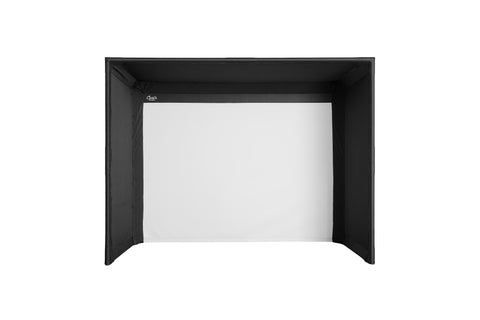
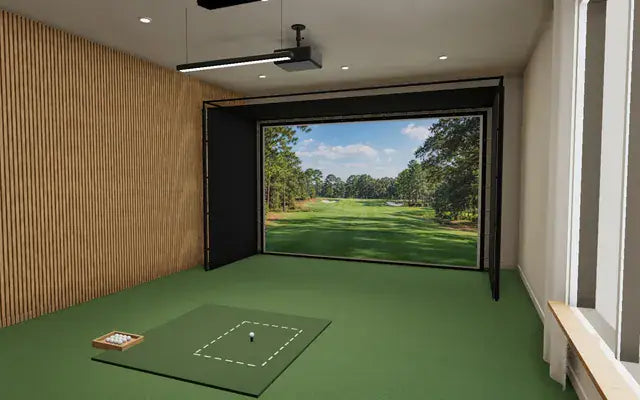
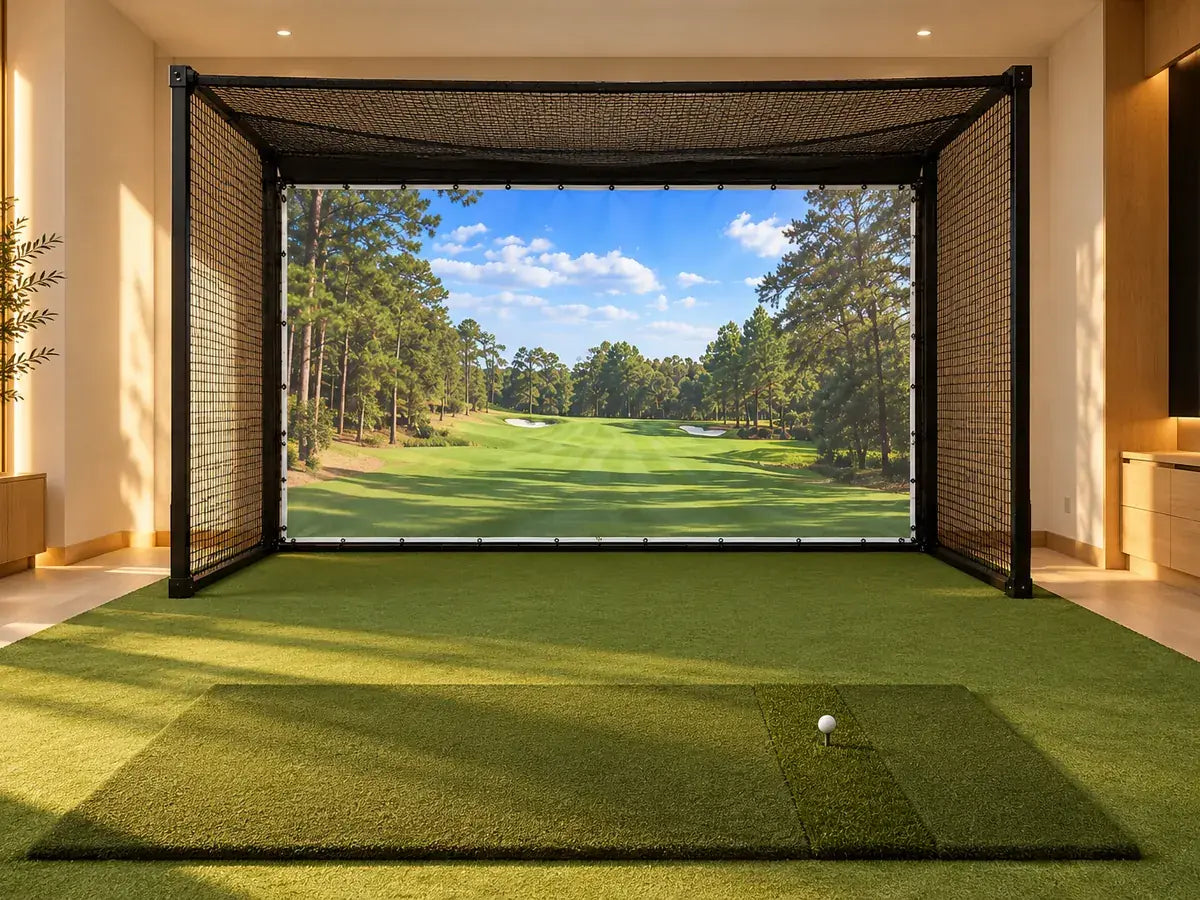
A hitting bay is the space you swing in: an enclosure with an impact screen in front, a hitting mat under you and a launch monitor reading each shot. Add a projector and software and it's a full golf simulator. Indoors it can go in a garage, a basement or a spare room; GolfBays lists its SimBox for outdoors too.
The four parts
The enclosure holds the screen and catches mis-hits with side and ceiling panels or netting. The impact screen takes the ball and shows the picture. The hitting mat is the surface you hit from. The launch monitor measures the shot, from the ceiling or the floor. Our enclosure guide helps you choose the frame.
Bay sizes from the enclosures we sell
Each maker's own sizes. The room needs more than the frame: the swing, the distance to the screen and the space behind you.
| Enclosure | Sizes the maker gives |
|---|---|
| SimSpace Golf Enclosure | Six sizes, inner frames from 2.6 × 2.5 × 1.5 m to 4.0 × 3.0 × 3.0 m (W × H × D) |
| GolfBays SimBox | Seven sizes, from 8'6 × 8'2 × 4'11 to 13'2 × 9'10 × 9'10 |
| GolfBays EasySim | One size, 10'9 W × 8'2 H × 3'3 D |
| Carl's Place DIY | Six sizes, outer frames 100 to 163.3 in wide and 95.8 to 112 in tall, all 59.125 in deep |
Our room size guide works out the room around each one.
Home bays priced at today's prices
Three home simulators built around a bay, from our complete golf simulators page.
| Home bay | Launch monitor | Room it needs (W × D × H) | About, at today's prices |
|---|---|---|---|
| Starter set (4 parts from 3 makers): EasySim, Mevo Gen2, mat and BenQ projector | FlightScope Mevo Gen2, behind the ball | 11 ft 5 in × 19 ft 2 in × 9 ft | $4,300 |
| GOLFJOY Spica 3 + SimSpace home simulator | GOLFJOY Spica 3, beside the ball | 13 ft 6 in × 18 ft 8 in × 9 ft | $6,800 |
| SwingCraft VTrack + SimSpace home simulator | SwingCraft VTrack DX10, on the ceiling | 13 ft 6 in × 18 ft 8 in × 8 ft 10 in | $10,100 |
"About" is the total rounded up to the next $100.
Venue bays vs a home bay
A venue bay is built for a crowd and for wear. TrackMan's benchmark for a commercial bay is at least 15 ft wide, 10 ft high and 18 ft deep, wider than most home bays so right- and left-handed players can rotate through. Our golf simulator business guide and business page cover multi-bay orders.
How big is a golf hitting bay?
The frame starts at about 8 ft wide and 8 ft tall for the smaller enclosures we sell, and the room around it is bigger. Carl's Place recommends 18 ft of room depth: 12 to 16 in between the screen and the wall, 10 to 12 ft from the tee to the screen and 7 ft behind the tee.
Today's prices: enclosures for a hitting bay
Live from our store: today's price, whether it ships now, and how to order.
| Product | Price today | How to buy | Ships from | Returns | Warranty |
|---|---|---|---|---|---|
| SimSpace Golf Simulator Enclosure | From $1,699.99 | Add to cart | SimSpace's U.S. warehouse | No set return window: only if SimSpace agrees in writing, case by case | 1 year on enclosures, impact screens, driving nets and hitting mats, case by case |
| GolfBays SimBox Golf Simulator Enclosure | From $1,399.30 | Add to cart | Clearwater, Florida | 30 days from the order date; GolfBays may charge a restocking fee, at least 15% on large items such as enclosures; you pay the return shipping unless GolfBays sends a free label | 9 months on the PRO+ impact screen, 6 months on GolfBays' other screens |
| GolfBays EasySim Golf Simulator Enclosure | $719.10 | Add to cart | Clearwater, Florida | 30 days from the order date; GolfBays may charge a restocking fee, at least 15% on large items such as enclosures; you pay the return shipping unless GolfBays sends a free label | 9 months on the PRO+ impact screen, 6 months on GolfBays' other screens |
| Carl's Place DIY Golf Enclosure Kit with Impact Screen | From $849.96 | Add to cart | Milton, Wisconsin (made to order) | 30 days from delivery, like-new; a 30% restocking fee if it's been used; you pay the return shipping | A defective part replaced free within 30 days of delivery; normal wear isn't covered (Carl's Place treats its products as wearable) |
| Carl's Place Pro Golf Simulator Enclosure Kit with Impact Screen | From $2,898.46 | Add to cart | Milton, Wisconsin (made to order) | 30 days from delivery, like-new; a 30% restocking fee if it's been used; you pay the return shipping | A defective part replaced free within 30 days of delivery; normal wear isn't covered (Carl's Place treats its products as wearable) |
Prices and stock are read live from our store each time this page loads, at each maker's advertised price. Taxes and any shipping charge show at checkout; the full terms are on each product page and in our refund policy.
Products in this guide
Sources
- SimSpace Golf, SimSpace Golf Enclosure: SimSpace lists its Golf Enclosure in six sizes, with inner frames from 2.6 × 2.5 × 1.5 m (SIM 1) to 4.0 × 3.0 × 3.0 m (SIM 6) (W × H × D); it has black velour side and ceiling panels that help contain stray shots and block outside light, and a 3-layer Platinum impact screen with a foam sound-dampening layer, and SimSpace asks for at least 50 cm behind and 20 cm on either side as a buffer for ball impacts (read Oct 31, 2026).
- GolfBays, SimBox Golf Simulator Enclosure: On its SimBox page GolfBays recommends a room depth of 4.5 m for photometric (camera) launch monitors and 5 m (16.4 ft) for radar-based ones, says the SimBox screen and enclosure withstand ball speeds of over 200 mph, lists it for indoors and outdoors, and notes that astroturf grass isn't included in the SimBox bundle (read Oct 31, 2026).
- Carl's Place, How to choose a golf simulator launch monitor: Launch monitors typically report ball speed, launch angle, spin, and carry; club data depends on the technology.
- GolfBays, SimBox Golf Simulator Enclosure: GolfBays sells the SimBox in seven sizes (W × H × D) from 8'6 × 8'2 × 4'11 to 13'2 × 9'10 × 9'10; its box list names aluminum poles, a black velvet surround, a triple-layer HD PRO+ impact screen and an instruction manual, and its features list click tubing that assembles in about 45 minutes with no screws or tools and folds down for storage.
- GolfBays, GolfBays EasySim Golf Simulator Enclosure: GolfBays sells the EasySim in one size, 10'9 W × 8'2 H × 3'3 D, sized for a 4:3 picture, with all poles, aluminum click tubing fittings, an integrated black fabric surround and its Lite impact screen, which it says gives a quiet impact sound suited to a garage; GolfBays says the 1 m depth gives flexibility in smaller rooms, where you have to hit closer to the screen.
- Carl's Place, DIY Golf Simulator Enclosure Kit Specifications (PDF): Carl's Place's DIY enclosure spec sheet lists six standard sizes with outer frames 100 to 163.3 in wide and 95.8 to 112 in tall, all 59.125 in deep from screen to front frame and 67.375 in in footprint depth (the backset rear fitting adds 8.25 in), with 1:1, 4:3 and 16:9 screens; it calls listing sizes simplified names, says to verify the actual outer dimensions, and quotes a 1 hour assembly.
- FlightScope, Mevo Gen2: FlightScope's Mevo Gen2 combines 3D Doppler radar with synchronized image processing to capture 20 club and ball parameters and runs up to 6 hours on its battery; indoors it goes 8 ft directly behind the ball with at least 8 ft of ball flight, and needs aluminum stickers or Titleist RCT balls for accurate spin.
- GOLFJOY, Spica 3: GOLFJOY's Spica 3 is a portable launch monitor with three high-speed cameras and two LED lights that tracks 27 ball, club and trajectory data points (golfjoy.com/products/spica-3, read Nov 10, 2026), runs up to 7 hours on its built-in battery, connects to GOLFJOY's apps by Wi-Fi and to a PC by Ethernet, reads any ball including pure white ones, needs club stickers for club data, and works with GOLFJOY PRO, GSPro, E6 Connect and Creative Golf.
- SwingCraft (LAON SwingCraft's U.S. distributor), VTrack Launch Monitor: SwingCraft lists a required floor-to-ceiling height of 106–122 in for VTrack; its dual high-speed cameras capture 23 data points per shot with no markers or stickers, and one setup supports both left- and right-handed players.
- TrackMan, Commercial Golf Simulator for Your Business: For a commercial bay, TrackMan says to plan for at least 15 ft wide, 10 ft high and 18 ft deep per bay, and to aim for at least 9–10 ft of ceiling so a full driver swing feels comfortable for most golfers.
- TrackMan, How much room do you need for a golf simulator: TrackMan says a single right-handed golfer has very different needs from a commercial bay where right- and left-handed players rotate through all day; it gives 15 ft+ of width as a strong benchmark for one golfer, says width matters even more in commercial and shared spaces because it supports both-handed play and safer movement around the hitting area, and calls a 10 ft+ ceiling the practical minimum, with more helping taller players.
- Carl's Place, Measuring Your Space For An Indoor Golf Simulator: Carl's Place builds its 18 ft recommended room depth from 12–16 in between the screen and the wall, 10–12 ft from the tee to the screen and 7 ft behind the tee, and says this covers the play area only; extras like seating need more space.
How this guide was made: ParVista Golf compiled it from manufacturers' published requirements and the public sources listed above. Requirements for a specific product always come from its manufacturer.


