
On this page · 16 sections
What does home indoor golf take?
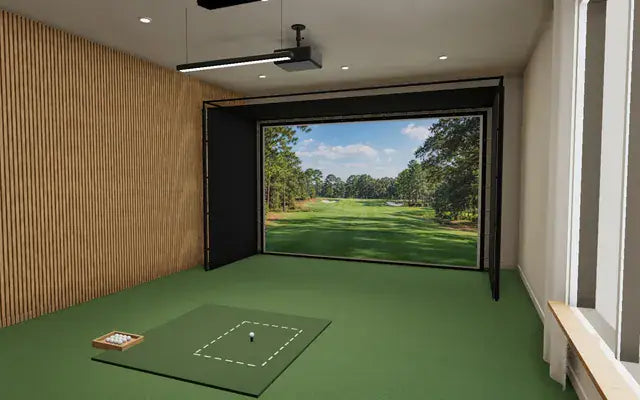
A room you can swing a driver in, and five or six parts: a launch monitor, something to hit into, a hitting mat, a projector, a computer or tablet, and usually course software. TruGolf gives a minimum room of 10 ft wide, 12 ft deep and 9 ft high, and recommends 12 to 16 ft wide, 15 to 20 ft deep and 10 ft high.
Whether you call it an indoor golf sim, a golf simulator for house use or a full indoor golf simulator at home, it starts with a tape measure, not a shopping cart. Measure the ceiling first, because it decides the most. Then use the tables below to see what fits and what it costs at today's prices. We sell every product named here, so we aren't neutral, and we don't install: each part ships from its maker for you to put together.
What a home golf simulator includes
Some kits put most of this in one order. Otherwise you choose each part. Foresight Sports names the launch monitor as the biggest cost driver in a setup, so it's the part to decide first.
| Part | What it does | Examples we sell |
|---|---|---|
| Launch monitor | Reads each shot: ball speed, launch angle, spin and carry, with club data depending on the unit | FlightScope Mevo Gen2, GOLFJOY Spica 3, Uneekor EYE MINI, GOLFJOY Rigel 3 |
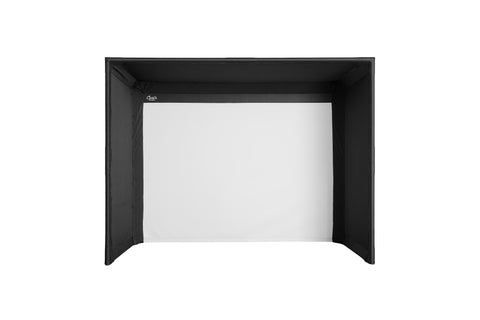
| Enclosure, net or screen | Stops the ball, and shows the course if it has an impact screen | SimSpace enclosure, GolfBays EasySim, Carl's Place DIY kit, SimSpace Practice Net |
| Hitting mat | Gives you a stance and a surface to strike from | SimSpace Tee Turf, Carl's HotShot |
| Projector | Puts the course on the impact screen. Not needed for practice into a net | BenQ AH500ST, BenQ AK700ST, BenQ LK936ST |
| Computer or tablet | Runs the software. FlightScope's Mevo Gen2 runs on a phone, tablet or PC; many others need a Windows PC | SurfThing Performance PC |
| Course software | Turns your numbers into a round. It may be included, bought once or renewed each year; GSPro, for example, is $250 a year | Creative Golf Advanced |
The room an indoor golf simulator for home needs
Here are the makers' general figures, then the smallest room for some of the setups we sell. A set's figures add its parts together: the enclosure, the distance from tee to screen, and where its launch monitor has to sit.
| Room or setup | Width | Depth | Ceiling |
|---|---|---|---|
| TruGolf's minimum | 10 ft | 12 ft | 9 ft |
| TruGolf's recommended room | 12 to 16 ft | 15 to 20 ft | 10 ft |
| A garage, by BenQ's minimum | 10 ft | 14 ft | 9 ft, under the door tracks |
| Spica 3 practice net set | 9 ft 6 in | 14 ft 8 in | 9 ft |
| Starter simulator set | 11 ft 5 in | 19 ft 2 in | 9 ft |
| GOLFJOY P8 kit, floor with turf | 10 ft | 13 ft 10 in | 9 ft 2 in, ideally 9 ft 10 in |
| Uneekor EYE XO2 home bay | 16 ft 7 in | 19 ft 8 in | 10 ft 5 in |
The GOLFJOY P8 figures are the kit's footprint on the floor, not extra swing room. Check your own swing too: Carl's Place suggests taking your longest club, likely the driver, into the space and swinging it without changing how you swing.
Where in home golf usually goes
A garage works if the door tracks leave enough height. BenQ says they often sit 1 to 2 ft below the ceiling, so measure to their lowest point. Our garage golf simulator packages list the sets that fit a 9 ft ceiling, and our garage guide covers cars, heat and damp.
A basement is already enclosed, and TruGolf calls it one of the most popular places for a home simulator. The usual limit is the height under beams and ducts: see our basement guide and guide to low ceilings. For a bedroom or apartment, our small room guide lists the smallest enclosures, screens and launch monitors we sell.
Home golf sim price bands from what we sell
The bands were checked against our catalog on November 3, 2026. The totals below are read from our store each time this page loads, rounded up to the next $100, and they're only each part's own price added up, before any shipping and tax. There's no package discount.
| Band | What it buys | An example, about this today | What you still add |
|---|---|---|---|
| Under $3,000 | A launch monitor, a practice net and a mat: every shot measured, no picture on a screen | Mevo Gen2 net set:$2,000 | A phone, tablet or Windows PC; sand or weights for the net's anchor bags |
| $3,000 to $5,000 | A first simulator with a picture on a screen | Starter simulator set:$4,300 | An iPad, iPhone or Windows PC; a projector mount and an HDMI cable |
| $5,000 to $10,000 | A camera launch monitor with an enclosure and a laser projector | Spica 3 and SimSpace:$6,800 | A Windows PC, course software, a projector mount and an HDMI cable |
| $10,000 to $20,000 | One maker's kit with the computer to run it | GOLFJOY P8 kit with a SurfThing Performance PC, each at the price on its own page | Nothing else to start: the kit has the projector mount, cabling and a year of GOLFJOY PRO |
| $20,000 and up | A full bay with its computer and software | Uneekor EYE XO2 home bay:$25,900 | A projector mount and cables; Uneekor's Pro membership to run the included software |
These are examples, not rankings. Carl's Place's own guide puts a realistic home simulator at about $3,000 to $20,000 or more. Our cost guide prices each part on its own, and yearly costs are in is a home golf simulator worth it?
What's the best golf simulator for home?
There's no single best golf simulator for home, because the room decides first. A low ceiling rules out overhead units, a short room rules out units that sit behind the ball, and the budget decides the rest. Measure, then compare what fits in the tables on this page.
The same goes for lists of the best at home golf simulators or the best indoor golf simulator: a unit that suits a 10 ft ceiling may not fit under 8 ft 6 in. Our best home golf simulator guide matches one pick to each kind of room.
That goes for the best indoor golf simulator for home and the best home golf simulator package too.
Golf simulators at home: one kit or separate parts?
One kit is the simpler order. GOLFJOY's P8 includes the launch monitor, an enclosure with an impact screen, a mat and turf, an Optoma GT2300HDR short-throw projector with its mount and cables, and a year of GOLFJOY software. You still add a Windows PC.
Separate parts let you fit an unusual room or start small. You could start with a net and a launch monitor, then add a screen and projector later: the SimSpace Practice Net takes a pop-on impact screen when you're ready. Today's prices, how to buy and each maker's terms:
| Product | Price today | How to buy | Ships from | Returns | Warranty |
|---|---|---|---|---|---|
| GOLFJOY P8 Golf Simulator Kit with Spica 3 Launch Monitor | $5,739 | Add to cart | GOLFJOY in Irvine, California, by curbside pallet freight | within 30 days of delivery if unused, with every part in the original packaging and our approval first; no restocking fee; you pay the return shipping to GOLFJOY | 1-year full-coverage warranty |
| FlightScope Mevo Gen2 Launch Monitor | $1,239 | Add to cart | its maker or Carl's Place | 30 days from delivery; a 15% restocking fee; you pay the return shipping; software is final sale | 12 months |
| GOLFJOY Spica 3 Portable Launch Monitor | $2,239 | Add to cart | GOLFJOY in Irvine, California, by FedEx ground | within 30 days of delivery if unused, with every part in the original packaging and our approval first; no restocking fee; you pay the return shipping to GOLFJOY | 1-year full-coverage warranty |
| SimSpace Deluxe Home Golf Practice Net | $449.99 | Add to cart | SimSpace's U.S. warehouse | No set return window: only if SimSpace agrees in writing, case by case | 1 year on enclosures, impact screens, driving nets and hitting mats, case by case |
| SimSpace Golf Simulator Enclosure | From $1,699.99 | Add to cart | SimSpace's U.S. warehouse | No set return window: only if SimSpace agrees in writing, case by case | 1 year on enclosures, impact screens, driving nets and hitting mats, case by case |
| GolfBays EasySim Golf Simulator Enclosure | $719.10 | Add to cart | Clearwater, Florida | 30 days from the order date; GolfBays may charge a restocking fee, at least 15% on large items such as enclosures; you pay the return shipping unless GolfBays sends a free label | 9 months on the PRO+ impact screen, 6 months on GolfBays' other screens |
| BenQ AH500ST 1080p Laser Short-Throw Golf Simulator Projector | $1,999 | Add to cart | BenQ America | 30 days from delivery; you pay the return shipping, plus a 15% restocking fee if the box has been opened | 3-year limited warranty, parts and labor |
Prices and stock are read live from our store each time this page loads, at each maker's advertised price. Taxes and any shipping charge show at checkout; the full terms are on each product page and in our refund policy.
Do I need a dedicated room for golf at home?
No, though the room has to be free while you play. A folding or retractable setup gives it back afterwards: SimSpace says two people can put its Practice Net up or take it down in 10 to 20 minutes, and our retractable screens page covers screens that roll up.
Will you install a golf simulator at my home?
No. We don't install, but every launch monitor, projector, enclosure, mat, screen and software license you buy from us comes with free setup help by email (send photos or a short video if that's easier). Our installation guide gives each maker's assembly time and tools.
How do I plan a golf simulator room design?
Start with the numbers, not the look: the ceiling at its lowest point, the width wall to wall and the depth from the screen to the back wall. Golf simulator room design then places the hitting position, the screen and the projector. A custom home golf simulator or a luxury home golf simulator uses the same numbers, with finish work around them that a builder handles. We sell the equipment and don't install. Our room planning steps goes through it, and we'll email you a free room plan.
What are some home golf simulator ideas?
Most home golf simulator ideas start with the space you already have. Basement golf simulator ideas have to work around ducts and beams, so see our basement guide. Garage golf simulator ideas have to clear the door tracks, so see our garage guide. A home built golf simulator can save on the frame, and our DIY guide covers that route.
What to do next
Measure the room, then pick the page that matches where you are. Not sure what fits? Send us your width, depth and ceiling height and the ParVista Team will email a written plan.
- Get a free room plan by email: usually within one business day
- Measure your room: the checklist
- Complete golf simulators: what each one includes, at today's prices
- Golf simulator packages under $5,000
- Garage golf simulator packages
- Basement golf simulator guide
- Where to buy a golf simulator: stores compared
- TrackMan, Foresight, SkyTrak and Full Swing alternatives
Can you really play golf in the house?
Yes. Golf in the house means hitting real balls into a screen or net while a launch monitor reads each shot and software shows where it went. The limit is the swing, so the room comes before anything else. Indoor golf for home use is mostly a question of ceiling height, depth and width.
That's what home virtual golf means: virtual golf at home is the course software on top of those parts.
How do I do a home golf simulator set up?
Home golf simulator setup follows the same order every time: measure the room, choose the launch monitor that fits it, choose the enclosure or screen, then the mat, the projector, and the computer and software. Golf simulators for home use usually arrive as separate parts from each maker, so check every part's room figures before you order.
For golf simulator room layout, our room planning steps goes step by step. For golf simulator room ideas built from parts we sell, see our starting rooms.
Is there an indoor golf simulator for sale as one order?
Yes, some come as one kit, and others are built from separate parts. If you're looking for an indoor golf simulator for sale with most of it in one box, our home golf simulator packages list what each one includes and what you still need to add.
Golf simulator packages for home use are on that page with today's totals, and home golf simulators for sale there list every part. To buy indoor golf simulator parts one at a time, start with the launch monitor.
Products in this guide
- FlightScope Mevo Gen2 Launch Monitor
- GOLFJOY Spica 3 Portable Launch Monitor
- Uneekor EYE MINI Launch Monitor
- SimSpace Golf Simulator Enclosure
- GolfBays EasySim Golf Simulator Enclosure
- Carl's Place DIY Golf Enclosure Kit with Impact Screen
- SimSpace Deluxe Home Golf Practice Net
- SimSpace Tee Turf Hitting Mat 4'11" x 4'11"
This guide names 7 more; see the links in the text above.
Shop by room
Sources
- TruGolf, Golf Simulator Room Dimensions: How Much Space Do You Really Need? (Mar 11, 2026): TruGolf gives a minimum room of 10 ft wide, 12 ft deep and 9 ft high and recommends 12–16 ft wide, 15–20 ft deep and 10 ft high; it calls 9 ft the minimum ceiling (for shorter golfers or flatter swings), 10 ft comfortable for most golfers and 10.5–12 ft ideal for taller players or more upright swings. Below 9 ft, it says, most full swings feel cramped and a driver risks the ceiling; 8 ft is possible but not recommended for most golfers, with short-game practice, putting and chipping workable. It says ceiling height can't easily be changed after installation, so prioritize it first.
- Carl's Place, How to choose a golf simulator launch monitor: Launch monitors typically report ball speed, launch angle, spin, and carry; club data depends on the technology.
- Foresight Sports, Complete Golf Simulator Room Setup Guide: All Equipment and Real Costs: Foresight Sports names the launch monitor as the biggest cost driver in a golf simulator setup, with a typical price range of $3,000 to $25,000+.
- FlightScope, Mevo Gen2: FlightScope says the Mevo Gen2 comes with its FS Golf Practice app (iOS, Android and PC), its FS Skills Challenges app and an E6 Connect 8-course bundle for iOS and PC, with no recurring fees and no subscription needed for core features or updates; it needs iOS 18, Android 14 or Windows 10/11 (64-bit), can be used indoors and outdoors, and should be stored in moderate temperatures, ideally 60–70°F.
- GSPro, home page: GSPro sells its simulator software as a subscription at $250 a year and says its lifetime add-on is no longer available; it needs a Windows 10 or 11 PC (at 1080p, at least a 3060 graphics card and 16 GB of RAM), lists VTrack, the FlightScope Mevo Gen2 and the Uneekor EYE MINI LITE among its supported launch monitors, and says Uneekor units need an active Uneekor Pro Package subscription.
- BenQ, Tips for Building a Golf Sim in Your Garage: BenQ says a garage golf simulator needs at least 9 ft of height, 10 ft of width and 14 ft of depth, says to proceed with care with an overhead launch monitor or a ceiling-mounted projector, suggests insulating the garage walls and all around the garage door, says a dehumidifier may be needed, and suggests keeping light off the screen with a dimmable light that has an adjustable angle.
- BenQ, Tips for Building a Golf Sim in Your Garage: With an overhead garage door, check the door won't hit a ceiling-mounted projector; door tracks often sit 1–2 ft below the ceiling, so measure height from the floor to the lowest point of the tracks.
- Carl's Place, Measuring Your Space For An Indoor Golf Simulator: Carl's Place gives a minimum ceiling of 8–9 ft, with limited swings depending on golfer height, swing type and club, and calls 10 ft the recommended height; taller players or more upright swings may need 10 ft or more. It suggests taking your longest club, likely the driver, into the space: if you can swing easily without changing how you swing, the space should work. It says to watch the ceiling height, rafters and any obstacles.
- TruGolf, Golf Simulator Room Dimensions: How Much Space Do You Really Need? (Mar 11, 2026): TruGolf says a basement is one of the most popular places for a home simulator, already enclosed and good at reducing noise; 8 ft ceilings come up often in basements, and most standard basements have 8 to 9 ft ceilings. With 9 ft or more a compact setup can work, and 10 ft or more is ideal for a full simulator; it says to check for support beams, HVAC ducts and other obstructions before measuring usable ceiling height.
- Carl's Place, How Much Does A Golf Simulator Cost?: Carl's Place says a realistic golf simulator that can actually analyze your swing costs between $3,000 and $20,000 or more; it puts a low-to-medium budget at $3,000–$7,000, a high budget at $10,000–$20,000 and an endless budget at upwards of $50,000.
- GOLFJOY, P8 Golf Simulator Package (golfjoy.com, read 2026-11-09): GOLFJOY sells its complete P8 simulator package with the Spica 3 launch monitor (GOLFJOY has retired the P7 version with the GDS Pro). GOLFJOY lists six included components: the Spica 3; an Optoma GT2300HDR short-throw projector with its mount and cabling; the enclosure and slow-rebound impact screen; a hitting mat and turf; the first 12 months of GOLFJOY Professional (30 courses, then $249 a year); and a ball tray, club stickers, a rubber tee and the Spica 3 carry backpack. A Windows simulator PC is not included. The enclosure is 10 ft wide × 8.2 ft high × 4.9 ft deep, and GOLFJOY says to allow about 16 ft of total room depth for a full swing; the spring-snap enclosure is designed for tool-less assembly in about three hours.
- SimSpace Golf, SimSpace Practice Net + Impact Screen: SimSpace says its Practice Net can be put up or taken down in 10–20 minutes by two people and can be used indoors or outdoors, but must be stored in a dry, warm place after use; weighted bags (filling not included) stretch out its side netting, and its pop-on impact screen attaches by bungee cords, links with a launch monitor and a compatible projector for a home simulator, and comes off again for plain net practice (read Oct 31, 2026).
How this guide was made: ParVista Golf compiled it from manufacturers' published requirements and the public sources listed above. Requirements for a specific product always come from its manufacturer.


