
On this page · 8 sections
How small can a golf simulator room be?
For full swings, about 10 ft wide, 12 to 15 ft deep and 9 ft high. TruGolf gives a minimum room of 10 ft wide, 12 ft deep and 9 ft high. For a basement, Carl's Place gives a minimum of 10 ft wide with an offset tee and 15 ft deep. Smaller than that, most full swings feel cramped, though TruGolf says putting and chipping still work.
Then try it. Carl's Place suggests taking your driver into the room: if you can swing easily without changing how you swing, the space should work.
Start with the ceiling and the swing
Height is the hardest thing to fix. TruGolf calls 9 ft the minimum ceiling and says 8 ft is possible but not recommended for most golfers. GolfBays says 8.5 to 9 ft can suit golfers under 5 ft 6 in, golfers over 6 ft generally need 10 ft or more, and you should plan for the person with the largest swing.
Under 9 ft, choose a launch monitor that stands on the floor. Uneekor designs its ceiling units to hang 9 to 10 ft up and says it can't guarantee their data outside that range. Our ceiling height guide goes further, with what fits under an 8 to 9 ft ceiling.
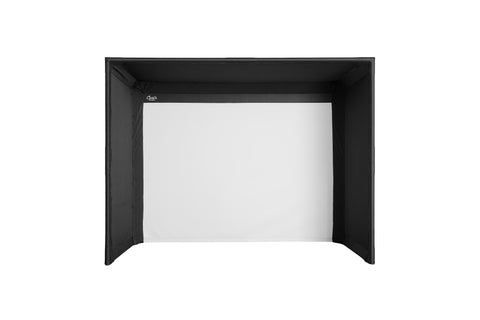
The smallest enclosures and screens we sell
Sorted from shallowest. Each size is the maker's own; add the space each maker asks for around it.
| Enclosure or screen | Size (W × H × D, maker's figure) | Space around it, and notes |
|---|---|---|
| SimSpace Practice Net | Frame 2.5 × 2.5 × 0.91 m (8 ft 2 in × 8 ft 2 in × 3 ft), with 3 m of side netting; a wide net is 3 m wide | At least 50 cm (20 in) behind and 20 cm (8 in) each side |
| GolfBays EasySim | 10 ft 9 in × 8 ft 2 in × 3 ft 3 in, one size | GolfBays says the 1 m depth suits smaller rooms, where you hit closer to the screen |
| SimSpace SLIM | 3.4 × 2.6 × 1.1 m outside (11 ft 2 in × 8 ft 6 in × 3 ft 7 in) | At least 50 cm (20 in) behind and 20 cm (8 in) each side |
| GolfBays SimBox | From 8 ft 6 in × 8 ft 2 in × 4 ft 11 in, in seven sizes | GolfBays recommends a ceiling of at least 9.2 ft and a width of at least 9.8 ft |
| GOLFJOY P8 | 10 ft × 8.2 ft × 4.9 ft | GOLFJOY says the steel frame snaps together with no tools |
| GolfBays Lux | From 9 ft 2 in × 8 ft 8 in × 4 ft 11 in, in four sizes | GolfBays lists it for home and commercial use |
| SimSpace Enclosure | SIM 1: 2.7 × 2.6 × 1.6 m outside (8 ft 10 in × 8 ft 6 in × 5 ft 3 in) | At least 50 cm (20 in) behind and 20 cm (8 in) each side |
| Carl's Place DIY enclosure | From 100 in wide and 95.8 in tall; 67.375 in footprint depth | 12 in behind recommended, 8.25 in minimum; 2–3 in above and each side |
| HomeCourse ProScreen 180 | Retractable 8 ft × 8 ft screen; turns a space 8 ft 6 in H × 10 ft W × 8 ft D into a golf setup | At least 6 in from the ceiling and 18 in from the wall; 10 to 12 ft front to back recommended |
| Elite Golf Portable Pro | 119.5 in long × 98.4 in high; 97.6 in deep with the side covers out | Folds into its own carrying bag |
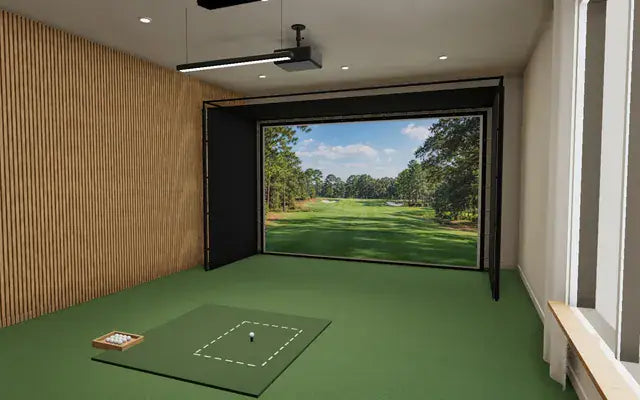
The depth here is the enclosure only. You still need room to swing in front of it: Carl's Place builds its recommended depth from 10 to 12 ft between the tee and the screen and 7 ft behind the tee. Our enclosure guide explains each type.
Launch monitors for a short or narrow room
Camera units usually suit short rooms better than radar. Radar sits behind the ball: FlightScope puts the Mevo Gen2 8 ft behind it with at least 8 ft of ball flight in front, and Carl's Place says radar units need 14 to 16 ft or more from the unit to the screen.
Camera units read the ball from beside it or above it. GOLFJOY asks for at least 2 yards from the ball to the screen for the Spica 3 and the GDS Pro. That's far less than the 10 to 12 ft Carl's Place advises standing back for bounce-back, so plan for the larger figure. Uneekor, maker of the floor-standing EYE MINI, recommends at least 12 ft from the screen to the tee for safety, and says 10 ft may do if you watch for bounce-back. It also asks for a room at least 13 ft wide, or 15 ft for golfers 6 ft or taller.(The GOLFJOY GDS Pro is retired by its maker and sold out; its page says more.)
If the ceiling allows a ceiling unit, two need less depth than most. SwingCraft asks for at least 9 ft 10 in from tee to screen and 8 ft 10 in of ceiling for the VTrack DX10. AccuGOLF places the tee 7 to 9 ft from the screen for the Hawkeye, in a room at least 12 ft wide, 9 ft high and 14 ft deep.
Narrow room? Carl's Place says that with less than 14 ft of width you can offset the tee to one side rather than centering it for both hands. Our Spica 3 vs EYE MINI comparison looks at the two floor units side by side.
Floor units need floor space of their own. Carl's Place says ground launch monitors need breathing room beside the ball, because a bumped unit gives bad reads.
Noise: what makes a setup quieter
The screen makes most of the noise. Multi-layer screens cushion the ball with a spacer layer, and Elite says that inner layer dampens the sound of the strike. A foam layer behind the screen slows the ball faster, which GolfBays says cuts wear, noise and bounce-back.
Of GolfBays' screens, it rates the PRO+ 10 out of 10 for noise and bounce-back and the Close-Knit Baffle 8, and calls the Close-Knit Baffle one of its quietest. Its Duo has a foam backing built in, and its foam layer backing screen goes behind any GolfBays screen. SimSpace's enclosures come with a foam sound-dampening layer, and GolfBays says the EasySim's Lite screen gives a quiet impact sound.
The projector adds a little: BenQ lists the AK700ST at 32 dB, or 29 dB in Eco mode. Our impact screens guide compares every screen we sell.
Apartments and neighbors: floors, walls and the people next door
A ball hitting a screen is never silent, so think about who's below and beside you. GolfBays makes its padded-base Putting Turf Landing Pad to keep floors safe and noise down, for apartment living or late-night practice. Under the mat, Carl's Place's floor tiles make a soft, stable subfloor, and its HotShot mat base adds cushioning and stops the mat sliding.
On the walls, Carl's Place says its acoustic tiles absorb sound and give walls and ceilings some protection, and that acoustic panels, added insulation or heavy curtains help with sound. Its safety tips also say to protect ceilings, walls, windows and neighboring homes.
If you rent, check your lease before you drill. A freestanding frame avoids most fixings: SimSpace and GolfBays frames push or click together without tools. HomeCourse's Projector Stand holds the projector on a 24 in wide base, up to 9 ft 6 in high, with nothing on the ceiling. Carl's Place's curtain tracks, by contrast, screw into ceiling joists. Planning a shared golf room for a whole building or HOA instead? See our amenity room guide.(HomeCourse’s projector stand is sold out right now; its page says more.)
Small-room setups that work, and today's prices
Three ways to build small, from what the makers say. A shallow enclosure such as the EasySim or SLIM, with a floor camera unit such as the Spica 3 or EYE MINI. A practice net with a pop-on screen, for a room where a full enclosure won't fit. Or the ProScreen 180, which rolls up when you need the room back.(The ProScreen 180 is sold out right now; its page says more.)
For the projector, BenQ says throw ratios around 0.5 can suit smaller rooms. Its AH500ST has a 0.499 ratio and the LK830ST 0.496. Where a ceiling mount won't work, Carl's Place makes a floor-mounted projector enclosure that sits between the golfer and the screen, though it still recommends a ceiling mount whenever possible.
Not sure it fits? Send us your room with its width, depth and ceiling height, and the ParVista Team will reply with what fits. Today's prices, read live from our store each time this page loads:
- Golf simulator room size: dimensions and space you need
- Best golf simulator for a basement
- Golf hitting net vs simulator enclosure
- Best home and indoor golf simulator 2026: picks by room and budget
- What fits a 10 × 12 ft room: each maker’s figures, with today’s prices
- What fits a 10 × 14 ft room: each maker’s figures, with today’s prices
- What fits a 12 × 12 ft room: each maker’s figures, with today’s prices
| Product | Price today | How to buy | Ships from | Returns | Warranty |
|---|---|---|---|---|---|
| SimSpace Deluxe Home Golf Practice Net | $449.99 | Add to cart | SimSpace's U.S. warehouse | No set return window: only if SimSpace agrees in writing, case by case | 1 year on enclosures, impact screens, driving nets and hitting mats, case by case |
| SimSpace Driving Net Impact Screen with 20 Bungee Cords | $129.99 | Add to cart | SimSpace's U.S. warehouse | No set return window: only if SimSpace agrees in writing, case by case | 1 year on enclosures, impact screens, driving nets and hitting mats, case by case |
| GolfBays EasySim Golf Simulator Enclosure | $719.10 | Add to cart | Clearwater, Florida | 30 days from the order date; GolfBays may charge a restocking fee, at least 15% on large items such as enclosures; you pay the return shipping unless GolfBays sends a free label | 9 months on the PRO+ impact screen, 6 months on GolfBays' other screens |
| SimSpace SLIM Golf Simulator Enclosure with Side Netting | $1,299.99 | Add to cart | SimSpace's U.S. warehouse | No set return window: only if SimSpace agrees in writing, case by case | 1 year on enclosures, impact screens, driving nets and hitting mats, case by case |
| GolfBays SimBox Golf Simulator Enclosure | From $1,399.30 | Add to cart | Clearwater, Florida | 30 days from the order date; GolfBays may charge a restocking fee, at least 15% on large items such as enclosures; you pay the return shipping unless GolfBays sends a free label | 9 months on the PRO+ impact screen, 6 months on GolfBays' other screens |
| Elite Screens Golf Portable Pro Folding Golf Simulator Screen and Enclosure | $1,780 | Add to cart | Elite's warehouse in Garden Grove, California | 30 days from the order date; a 25% restocking fee once opened | 6 years on the Golf Bay Pro and Golf Portable Pro bought from us (Elite confirmed this in writing); 2 years on the GolfSim DIY screen |
| GOLFJOY Spica 3 Portable Launch Monitor | $2,239 | Add to cart | GOLFJOY in Irvine, California, by FedEx ground | within 30 days of delivery if unused, with every part in the original packaging and our approval first; no restocking fee; you pay the return shipping to GOLFJOY | 1-year full-coverage warranty |
| BenQ AH500ST 1080p Laser Short-Throw Golf Simulator Projector | $1,999 | Add to cart | BenQ America | 30 days from delivery; you pay the return shipping, plus a 15% restocking fee if the box has been opened | 3-year limited warranty, parts and labor |
| GolfBays Putting Turf Landing Pad | From $269.10 | Add to cart | Clearwater, Florida | 30 days from the order date; GolfBays may charge a restocking fee, at least 15% on large items such as enclosures; you pay the return shipping unless GolfBays sends a free label | 9 months on the PRO+ impact screen, 6 months on GolfBays' other screens |
| Carl's Place Golf Room Acoustic Tiles (25-Pack) | $279.95 | Add to cart | Milton, Wisconsin (made to order) | 30 days from delivery, like-new; a 30% restocking fee if it's been used; you pay the return shipping | A defective part replaced free within 30 days of delivery; normal wear isn't covered (Carl's Place treats its products as wearable) |
| HomeCourse ProScreen 180 Retractable Golf Screen | $2,299 | Sold out | HomeCourse's Florida warehouse, by FedEx | 30 days from the order date, with HomeCourse's approval; a 15% restocking fee; you pay the return shipping | 1 year on the ProScreen 180 and its accessories |
| Uneekor EYE MINI Launch Monitor | $1,999 | Sold out | its maker or Carl's Place | 15 days from activating the software or 60 days from delivery, whichever comes first; a 15% restocking fee; you pay the return shipping | 2 years on overhead units; 1 year on the EYE MINI, EYE MINI LITE and accessories |
Prices and stock are read live from our store each time this page loads, at each maker's advertised price. Taxes and any shipping charge show at checkout; the full terms are on each product page and in our refund policy.
Products in this guide
- SimSpace Deluxe Home Golf Practice Net
- GolfBays EasySim Golf Simulator Enclosure
- SimSpace SLIM Golf Simulator Enclosure with Side Netting
- GolfBays SimBox Golf Simulator Enclosure
- HomeCourse ProScreen 180 Retractable Golf Screen
- GOLFJOY Spica 3 Portable Launch Monitor
- Uneekor EYE MINI Launch Monitor
- GolfBays Close Knit Baffle Golf Simulator Impact Screen
This guide names 3 more; see the links in the text above.
Shop by room
Sources
- TruGolf, Golf Simulator Room Dimensions: How Much Space Do You Really Need? (Mar 11, 2026): TruGolf gives a minimum room of 10 ft wide, 12 ft deep and 9 ft high and recommends 12–16 ft wide, 15–20 ft deep and 10 ft high; it calls 9 ft the minimum ceiling (for shorter golfers or flatter swings), 10 ft comfortable for most golfers and 10.5–12 ft ideal for taller players or more upright swings. Below 9 ft, it says, most full swings feel cramped and a driver risks the ceiling; 8 ft is possible but not recommended for most golfers, with short-game practice, putting and chipping workable. It says ceiling height can't easily be changed after installation, so prioritize it first.
- Carl's Place, How to Build a Basement Golf Simulator: For a basement, Carl's Place gives a minimum width of 10 ft with an offset hitting area and recommends 14 ft or more for centered hitting for right- and left-handed golfers; a minimum depth of 15 ft (1 ft behind the screen, 10 ft screen to ball, 4 ft behind the ball) and a recommended 18–20 ft (1 ft, 10–12 ft and 7 ft); and says radar units need 14–16 ft or more from the unit to the screen.
- Carl's Place, Measuring Your Space For An Indoor Golf Simulator: Carl's Place gives a minimum ceiling of 8–9 ft, with limited swings depending on golfer height, swing type and club, and calls 10 ft the recommended height; taller players or more upright swings may need 10 ft or more. It suggests taking your longest club, likely the driver, into the space: if you can swing easily without changing how you swing, the space should work. It says to watch the ceiling height, rafters and any obstacles.
- GolfBays, Mastering the Perfect Set-Up: How High Should Your Ceiling Be for a Golf Simulator? (May 14, 2024): GolfBays recommends a ceiling of at least 10 ft in general, depending on your height and swing, says a setup might work at 9 ft but anything under 9 ft could hamper it, that golfers over 6 ft generally need 10 ft or more, and that 8.5–9 ft can suit golfers under 5 ft 6 in; it suggests planning for the person with the largest swing, and notes that a very tall ceiling can make mounting the projector harder.
- Uneekor Help Center, How much space is needed for setup?: Uneekor designs its overhead launch monitors to be mounted 9–10 ft off the ground, measured from the top of the hitting area to the bottom of the mounting bracket, and says it can't guarantee their data accuracy outside that range.
- SimSpace Golf, SimSpace Practice Net + Impact Screen: SimSpace's Practice Net + Impact Screen page gives the standard net's frame as 2.5 × 2.5 × 0.91 m (W × H × D) with 3 m of side netting, and the wide net's frame as 3 × 2.5 × 0.91 m; it says to leave at least 50 cm behind and 20 cm on either side as a buffer for ball impacts, and calls all measurements estimates (read Oct 31, 2026).
- GolfBays, GolfBays EasySim Golf Simulator Enclosure: GolfBays sells the EasySim in one size, 10'9 W × 8'2 H × 3'3 D, sized for a 4:3 picture, with all poles, aluminum click tubing fittings, an integrated black fabric surround and its Lite impact screen, which it says gives a quiet impact sound suited to a garage; GolfBays says the 1 m depth gives flexibility in smaller rooms, where you have to hit closer to the screen.
- SimSpace Golf, SimSpace SLIM Golf Enclosure: SimSpace designs its SLIM enclosure for shallow simulator rooms: its SIM 0 frame measures 3.3 × 2.5 × 1 m inside and 3.4 × 2.6 × 1.1 m outside (W × H × D), with a 4:3 Platinum impact screen and side netting that attaches with Velcro and is held out by weighted bags (filling not included); SimSpace quotes about 20–30 minutes to set it up with two people, and asks for at least 50 cm behind and 20 cm on either side of the enclosure as buffer space for ball impacts.
- GolfBays, SimBox Golf Simulator Enclosure: GolfBays sells the SimBox in seven sizes (W × H × D) from 8'6 × 8'2 × 4'11 to 13'2 × 9'10 × 9'10; its box list names aluminum poles, a black velvet surround, a triple-layer HD PRO+ impact screen and an instruction manual, and its features list click tubing that assembles in about 45 minutes with no screws or tools and folds down for storage.
- GolfBays, SimBox Golf Simulator Enclosure (FAQ): For comfortable swings with any club, GolfBays recommends a ceiling of at least 2.8 m (9.2 ft), ideally 3 m (9.8 ft), and a width of at least 3 m (9.8 ft).
- GOLFJOY, P8 Golf Simulator Package (golfjoy.com, read 2026-11-09): GOLFJOY sells its complete P8 simulator package with the Spica 3 launch monitor (GOLFJOY has retired the P7 version with the GDS Pro). GOLFJOY lists six included components: the Spica 3; an Optoma GT2300HDR short-throw projector with its mount and cabling; the enclosure and slow-rebound impact screen; a hitting mat and turf; the first 12 months of GOLFJOY Professional (30 courses, then $249 a year); and a ball tray, club stickers, a rubber tee and the Spica 3 carry backpack. A Windows simulator PC is not included. The enclosure is 10 ft wide × 8.2 ft high × 4.9 ft deep, and GOLFJOY says to allow about 16 ft of total room depth for a full swing; the spring-snap enclosure is designed for tool-less assembly in about three hours.
- GolfBays, GolfBays Lux Golf Simulator Hitting Enclosure: GolfBays lists the Lux in four sizes (Oct 30, 2026): 9 ft 2 in × 8 ft 8 in × 4 ft 11 in, 10 ft 10 in × 8 ft 8 in × 4 ft 11 in, 12 ft 6 in × 9 ft 4 in × 5 ft 11 in and 14 ft 9 in × 9 ft 8 in × 7 ft 7 in (W × H × D), for commercial and home use, with an aluminum box-section frame, a dual-sided quilted velvet surround, a PRO+ impact screen, bungees, an adjustable projector or launch monitor mount and DIY build instructions.
- SimSpace Golf, SimSpace Platinum Golf Enclosure: SimSpace lists its Platinum enclosure in sizes SIM 1 to SIM 6: SIM 1 to SIM 4 have inner frames 2.6, 3.0, 3.6 or 4.0 m wide, 2.5 m tall and 1.5 m deep, with outer frames 2.7 to 4.1 m wide, 2.6 m tall and 1.6 m deep, and SIM 5 and SIM 6 are 3.0 m tall and deep inside and 3.1 m tall and deep outside; the screens are 1:1, 4:3 or 16:10 depending on size. SimSpace asks for at least 50 cm behind and 20 cm on either side of the enclosure as buffer space for ball impacts, and calls all measurements estimates.
- Carl's Place, DIY Golf Simulator Enclosure Kit Specifications (PDF): Carl's Place's DIY enclosure spec sheet lists six standard sizes with outer frames 100 to 163.3 in wide and 95.8 to 112 in tall, all 59.125 in deep from screen to front frame and 67.375 in in footprint depth (the backset rear fitting adds 8.25 in), with 1:1, 4:3 and 16:9 screens; it calls listing sizes simplified names, says to verify the actual outer dimensions, and quotes a 1 hour assembly.
- Carl's Place, DIY Golf Enclosure Kit with Impact Screen: Carl's Place's DIY kit includes an impact screen in Standard, Preferred, Premium or High-Contrast Gray Premium material, the BlackStop enclosure and the corner fittings for a frame of 1-inch EMT, which you buy at a hardware store unless you add its Pipe Framing Kit; Carl's recommends 12 in behind the enclosure (8.25 in minimum for the rear fittings) and says the kit assembles in about an hour depending on size, a bit faster with a helper.
- Carl's Place, How to Choose the Best Golf Simulator Enclosure Size: Carl's Place recommends a room at least 14 ft wide and 18 ft deep with 9–10 ft ceilings, doesn't recommend going smaller than 96 in high or 100 in wide for most customers, and says to leave at least 2–3 in above the enclosure (closer to 6–7 in for its Curved kit) and 2–3 in on each side.
- HomeCourse Golf, ProScreen 180: HomeCourse says the ProScreen 180 mounts on a ceiling, a wall or its Pro Rack and turns a space of 8'6 H × 10' W × 8' D into a golf setup; it needs at least 6 in from the ceiling and 18 in from the wall, measures 10'6 wide with the Pro Arms extended, comes with 10 to 12 ft front to back recommended, and lets you fold out one or both Pro Arms, closing one for right- or left-handed golfers.
- HomeCourse Golf, ProScreen 180 (shop): HomeCourse says its screen is 8 ft wide by 8 ft high, and the ProScreen 180 comes with the retractable screen and enclosure, a ceiling mount kit, a charging cable, a remote control and an easy-reach pole.
- Elite ProAV, Golf Portable Pro Dimensions Table (PDF): Elite ProAV's dimensions table lists the Golf Portable Pro (8' × 10') at 119.5 in overall length and 98.4 in overall height, 97.6 in from the back foot to the front of the fully extended side covers, with a 111.6 × 62.8 in viewable area and a 63 × 10.2 × 7.1 in carrying bag, and notes the data may be off by ±1 in.
- Elite ProAV, Golf Portable Pro Series: Elite ProAV describes the Golf Portable Pro as a collapsible, portable golf impact screen on a lightweight aluminum folding frame that assembles in minutes with no special tools, with top, left and right enclosure covers, triangular side net extensions, a tightly woven ImpactWhite 350 screen that withstands ball speeds up to 150 mph, and a padded carrying bag that stores the entire product.
- Carl's Place, Measuring Your Space For An Indoor Golf Simulator: Carl's Place builds its 18 ft recommended room depth from 12–16 in between the screen and the wall, 10–12 ft from the tee to the screen and 7 ft behind the tee, and says this covers the play area only; extras like seating need more space.
- Austad's, Camera vs Radar Launch Monitors: Radar units sit behind the ball and need ball flight in front; camera units sit beside the ball and read impact directly.
- FlightScope, Mevo Gen2: FlightScope's Mevo Gen2 combines 3D Doppler radar with synchronized image processing to capture 20 club and ball parameters and runs up to 6 hours on its battery; indoors it goes 8 ft directly behind the ball with at least 8 ft of ball flight, and needs aluminum stickers or Titleist RCT balls for accurate spin.
- GOLFJOY, Spica 3: For indoor use GOLFJOY asks for at least 2 yards (about 1.8 m) from the hitting position to the screen or net and a ceiling of 2.75–3.1 m (9–10.2 ft) for the Spica 3, and lines its bottom edge up parallel with the edge of the hitting mat.
- GOLFJOY, GDS Pro Golf Launch Monitor: For the GDS Pro, a floor unit, GOLFJOY asks for at least 2 yards (about 1.8 m) from the ball to the screen or net and gives an ideal indoor ceiling of 2.75 to 3.1 m (9 to 10.2 ft); its hitting zone is 19 cm long and 14 to 17 cm wide.
- Carl's Place, How to Choose the Best Golf Simulator Enclosure Size: Stand at least 10–12 ft from the screen; golfers who stand closer than 10 ft get more bounce-back and a higher risk of injury.
- Uneekor Help Center, How much space is needed for setup?: Uneekor recommends at least 12 ft from the impact screen to the tee for safety, and says 10 ft may suffice if that can't be met, with a watch for ball bounce-back.
- Uneekor Help Center, How much space is needed for setup?: Uneekor says the room should be at least 13 ft wide, wall to wall, to allow full driver swings, and at least 15 ft wide for golfers 6 ft or taller.
- SwingCraft (LAON SwingCraft's U.S. distributor), VTrack setup: SwingCraft's VTrack setup page gives a ceiling height of 8 ft 10 in to 10 ft 2 in (2,700–3,100 mm) and at least 9 ft 10 in (3,000 mm) from tee to screen, and asks for a stable indoor space and a level ceiling; the unit mounts with all 7 supplied screws, offset toward the screen by 32.3–37.2 in depending on the ceiling height, plugs into a grounded outlet and connects with the included CAT6 cable directly to the PC's Gigabit Ethernet port.
- AccuGOLF, Installing Your Simulator: AccuGOLF's installation notes place the tee 7–9 ft from the impact screen and the Hawkeye sensor 31 in from the tee with a 9 ft ceiling or 34 in with a 10 ft ceiling, 4–5 in left of center, with the ceiling mount's arrows pointing at the screen; it asks for a flat, level floor and says misreads come mainly from too little light on the ball, so it recommends a spotlight.
- AccuGOLF, Hawkeye Simulator: AccuGOLF's minimum room for the Hawkeye is 12 ft wide, 9 ft high and 14 ft deep for single-handed rooms, and 16–17 ft wide, 9 ft high and 14 ft deep for rooms built for both hands; its hitting zone is 24 in wide by 12 in long.
- Carl's Place, Measuring Your Space For An Indoor Golf Simulator: Carl's Place recommends a room at least 10 ft wide for indoor golf, and at least 14 ft wide if the tee is centered to accommodate both right- and left-handed golfers; with less width, it says you can offset the tee.
- Carl's Place, Golf Simulator Seating Ideas for Safer Setups (page read 2026-11-01): Carl's Place says the safest spectator seating is behind the hitting area and outside the golfer's swing zone; it ranks the worst places as between the golfer and the screen, in the swing path, too close behind the golfer, behind the screen (don't let kids or pets wander behind the impact screen while someone is hitting), in the walkway and next to floor equipment, says to keep a clear path around the simulator, and suggests compact, movable seating such as folding chairs in small rooms.
- The Indoor Golf Shop, What are the differences between SIG brand impact screens?: Multi-layer screens put spacer yarns between two polyester layers to cushion the ball (quieter, less bounce-back); single-layer woven screens cost less but can carry shorter warranties.
- Elite Screens, GolfSim DIY Screen Series: ImpactWhite 1145: In a three-layer screen, the internal spacer layer dampens the noise of the ball hitting the screen.
- GolfBays, Best Golf Impact Screens: Material, Size, Image Quality: A foam layer hung behind the impact screen slows the ball much faster than the screen alone, reducing wear, noise and bounce-back.
- GolfBays, Impact Screen FAQs & Guidance: GolfBays rates its screens from 1 to 10 (most positive): Lite (light home use) durability 6, image quality 6, noise and bounce-back 5; PRO Reversible (heavy home use, HD) 7, 7 and 4; Close-Knit Baffle (heavy home and commercial use) 9, 5 and 8; PRO+ (heavy home and commercial use, HD/4K) 10, 9 and 10.
- GolfBays, Close-Knit Baffle Simulator Impact Screen: GolfBays describes the Close-Knit Baffle as a close-knit polyester archery baffle screen whose small holes dissipate sound, one of its quietest options; it's single layer but can be reversed, has eyelets every 8 in around all four sides, and comes in 11 sizes from 7'6 × 8'5 to 16'4 × 9'10, all dimensions including the white surround.
- GolfBays, GolfBays Duo Impact Screen: GolfBays describes the Duo as a two-layer impact screen: a nylon weave front that keeps light on the screen and an integrated foam backing that keeps impact noise to a minimum, reduces ball bounce and helps extend the screen's life; it lists 12 sizes, from 7'6 × 8'5 to 16'5 × 13'1.
- GolfBays, Foam Layer Backing Screen: GolfBays says its foam layer backing screen sits directly behind an existing impact screen, softening and quietening each strike, cutting ball bounce-back and lengthening the impact screen's life; it suits any GolfBays impact screen and the SimBox, has eyelets every 8 in on all four sides and comes in six sizes.
- SimSpace Golf, SimSpace Platinum Golf Enclosure: SimSpace says its enclosure is built on sturdy push-connect metal poles, takes about 20–30 minutes to set up with two people, and is easy to assemble and dismantle for flexible spaces like garages or spare rooms; the box holds black velour siding, a 3-layer Platinum impact screen with a foam sound-dampening layer, the metal poles, bungee cords and Velcro straps, and foam padding tubes.
- BenQ, AK700ST Specifications (read 2026-11-01): BenQ's AK700ST specifications list a laser light source rated 20,000 hours, input lag of 8.4 ms (1080p 240 Hz), 16.7 ms (1080p 120 Hz) and 33.4 ms (1080p and 4K 60 Hz), and acoustic noise of 32 dB (29 dB in Eco)
- GolfBays, Putting Turf Landing Pad: GolfBays describes its Putting Turf Landing Pad as realistic synthetic turf for putting practice at home that bounces back consistently, in six sizes from 8'6 × 4'11 to 13'2 × 4'11 that match its SimBox enclosure, with a padded base that keeps floors safe and noise down, for apartment living or late-night practice (read Oct 31, 2026).
- Carl's Place, Carl's Golf Room Floor Tile System: Carl's Place's floor tile system is interlocking 1.25 in foam tiles, 40.25 × 40.25 in, that make a soft, stable subfloor for a simulator room; turf can be laid over them and a hitting mat or strip blended into the floor.
- Carl's Place, Carl's HotShot Golf Mat System: Carl's Place sells the HotShot mat 1¾ in thick in 4 × 5 ft and 5 × 8 ft (offset hitting area) and 4 × 9 ft and 6 × 10 ft (centered hitting area); it says the optional EPDM rubber base stops the mat shifting during powerful swings and adds cushioning to protect your joints, and calls its Foam Divot insert the most forgiving option on your joints.
- Carl's Place, Golf Room Acoustic Tiles: Carl's Place says its golf room acoustic tiles, 24 × 24 in and 9 mm thick in packs of 25 covering 100 sq ft, absorb sound, help control ambient light and give walls and ceilings some protection; they're adhesive-backed for plywood, drywall or painted drywall (the adhesive can damage paint), with an extra fastener suggested on a ceiling.
- Carl's Place, How to Build a Basement Golf Simulator: Carl's Place says concrete basement slabs get cold and a subfloor, foam tiles or turf padding helps with temperature and joint comfort; basements hold more moisture, so a dehumidifier protects the turf, impact screen, electronics and projector; lights should be placed so they don't cast harsh shadows on the ball, and the darker room gives a brighter, cleaner picture; acoustic panels, added insulation or heavy curtains help with sound.
- Carl's Place, Carl's MultiSport Simulator Package (page read 2026-11-01): Carl's Place's MultiSport Simulator Package combines its 8.5 × 14.5 × 8 ft Pro enclosure with a Premium or High-Contrast Gray screen, the pipe framing kit, a safety baffle, the TruGolf MultiSport ARCADE with its Sport Pack, an LG ProBeam BU53RG projector and a projector mount; Carl's says to allow about 6 ft on every side for a playable area, to stand 10–12 ft from the screen to stay safe from bounce-back, and that the setup needs a space at least 113 in high, 188 in wide and 15 ft deep. Its safety tips say to protect ceilings, walls, windows, cars and neighboring homes, and to keep children, pets and spectators out of swing range; the PC minimum is an Intel i3, 8 GB of RAM, an Nvidia 1070, Windows 10 and an internet connection.
- HomeCourse Golf, Projector Stand: HomeCourse says its Projector Stand makes it easy to set up, break down and move a projector, with a 24 in wide base and a height range up to 9 ft 6 in.
- Carl's Place, Hardware Kit to Ceiling Mount Curtain: Carl's Place's curtain hardware kit has galvanized steel track, rollers, two stops and screws: one track and 12 rollers for a 48 in curtain, two tracks and 24 rollers for 96 in, and three tracks and 36 rollers for 144 in; the tracks screw into ceiling joists, the size must match the curtain, and the kit is only for Carl's golf room curtains, not its screens.
- BenQ, Measure Ideal Screen Size and Projection Distance for Your Golf Simulator (Sep 15, 2026): BenQ says throw distance is how far the projector must sit from the screen to make a given picture size, and gives throw ratio = throw distance ÷ image width; for a 16:9 projector showing a 4:3 or 1:1 picture, throw ratio = (throw distance × 0.5625) ÷ image height, and × 0.6277 for a 16:10 projector. Its example: a 16:9 projector with a 0.8 throw ratio making a 14 ft wide picture sits about 11.2 ft from the screen. It says golf simulator projectors commonly use throw ratios from 0.5 to 1.1, calls 0.69–0.89 a practical balance for standard home setups that typically lets the projector sit 2–3 ft behind the hitting area, and says ratios around 0.5 can suit smaller rooms.
- BenQ, AH500ST specifications: BenQ lists the AH500ST as a 1080p projector with 4,000 ANSI lumens and a 0.499 throw ratio.
- BenQ, LK830ST specifications: BenQ lists the LK830ST as a 4K UHD projector with 4,000 ANSI lumens and a 0.496 throw ratio, for screens up to 10 ft tall in small spaces.
- Carl's Place, Carl's Floor Mounted Projector Enclosure: Carl's Place makes its floor-mounted projector enclosure for golfers who can't mount a projector overhead because of extremely low or high ceilings; it sits on the floor between the golfer and the screen, is ideal with a projector that has horizontal keystone set off center, isn't meant to take repeated direct shots, and Carl's still recommends a ceiling mount whenever possible.
How this guide was made: ParVista Golf compiled it from manufacturers' published requirements and the public sources listed above. Requirements for a specific product always come from its manufacturer.


